Thanks to Terry for these two superb photos of Golden Bay Air's BN Islander ZK-EVO doing engine tun ups today...
.JPG) |
| Golden Bay Air's Britten Norman Island ZK-EVO at Nelson on 16 June 2022... It is still waiting for its rego to be painted on |
.JPG)

This blog has tries to record the history of NZ's domestic airline operations, past and present, and in particular the smaller "3rd level" airlines. Comments, corrections or contributions are welcome. Liam is focussing on the current operation of our airlines - heliliamnz@gmail.com. Steve is continuing to potter around on the airline histories - westland831@gmail.com
Thanks to Terry for these two superb photos of Golden Bay Air's BN Islander ZK-EVO doing engine tun ups today...
|
| Golden Bay Air's Britten Norman Island ZK-EVO at Nelson on 16 June 2022... It is still waiting for its rego to be painted on |
.jpg)
Check out a great interview with Barrier Air's CEO Grant Bacon @ https://www.youtube.com/watch?v=5wOFGkil77k
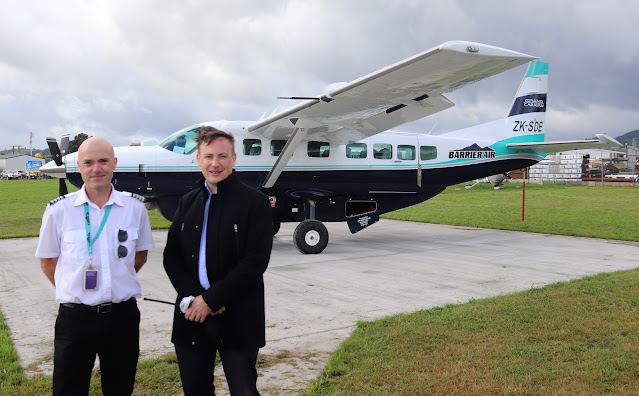 |
| Barrier Air's Daryl Williamson (left) and Grant Bacon (right) after the airline's first Auckland-Whitianga service... |
.jpg)
At the first annual general meeting of the Opotiki Aero Club, Club President, Dr H J Mail, gave an excellent summary of the Club’s origins as reported in the Opotiki News.
The club was formed in April 1946 when the first general meeting took
place, and although the number of people present on that occasion was small,
their enthusiasm was great. The keenness of the officers appointed augured well
for the successful running of the club. The fact that Opotiki already possessed
an aerodrome suitable for use by light aircraft was a very important factor
which made the formation of the club worthwhile. On the other hand, the lack of
aerodrome equipment and staff at Opotiki, and the prohibitive cost of acquiring
and maintaining an aircraft were factors which would soon have ruined the club
were it not for the assistance of the Tauranga Aero Club which offered to bring
down aircraft for flying instruction and passenger flights.
The first four months were occupied by the secretary and committee in the preliminary work of getting the club into running order. This was followed by the first visit of aircraft from the Tauranga Club on August 17th 1946. This was the Opotiki Aero Club’s official opening. The Tauranga Aero Club’s instructor and engineer, Ron Graham and Les Johnston, flew their two Tiger Moths, ZK-AJT and ZK-AJU, over to Opotiki and they offered flights over the town or any area the passenger desired. At the end of August, flying training began for some of the keener members. Passenger flights were a feature of the earlier visits of the machines, but in the later months these became fewer, and the aircraft were occupied mostly in giving flying instruction to members.
The club has survived various factors during the year, the principal troubles towards the close of 1946 being the presence of marker boards on the aerodrome to delineate the runways, and also, the growth of grass. This caused the cessation of flying operations for several weeks in November and December, on accounts of the runways not being in the direction of the prevailing winds, thus making landings hazardous. Since then the grass has been kept short and the aerodrome maintained in excellent condition, thereby enabling the enthusiast's to proceed with uninterrupted flying training.
Another of the hurdles of the club has been to meet the cost of the flying time of the aircraft from Tauranga to Opotiki and back. This has been met by a slight increase in the flying fees for trainees, and has been ameliorated by considerable reduction in the Tauranga. Club’s charge in the latter half of the year, a factor which was much appreciated by our club.
On odd occasions the aircraft have proved their worth in taking passengers on urgent journeys to Auckland, Thames, Gisborne and Napier etc. The general public do not yet seem to have fully appreciated the value of this method of travel, which is sale and timesaving. One of the main objects of the club is to enable members to learn to fly, and in this category several have already qualified for their "A” license’s. Flying commenced on the 17th of August 1946 the hours flown being as follows:—Dual 81¾, solo 42¾, passenger 40. Total 164½ hours.
At the same time, while the Opotiki Aero Club was getting airborne, the town fathers were looking for the resumption of the town’s pre-War air service. From the 20th of March 1939 Union Airways had commenced a short-lived Auckland-Tauranga-Opotiki-Gisborne service. In November 1947 the Chamber of Commerce wrote to the National Airways Corporation in connection with a suggestion that an air service with smaller ’planes should include Opotiki in a feeder service to connect with the main routes. A reply from National Airways stated that Opotiki was included in the plan for a service but it could not be undertaken until ’planes became available. The service would be instituted as soon as possible.
The town fathers were also keen to extend the Opotiki aerodrome and had made approaches to Government to seek their assistance in doing this. In a letter to the Opotiki County Council, the Minister of Defence, Hon. P. Jones, wrote, ‘‘The Aerodrome in its present condition does not supply sufficient margin of safety as recommended by the International Civil Aviation Organisation. It is the intention of the Government to bring all secondary aerodromes up to ICAO standards although, as Opotiki is not on international air routes, there is no obligation for the Government to do this. However, even with the type of aircraft which are likely to be used on internal services, it is thought that Opotiki is not of the required standard, having a limited area and slippery surface when wet. Your Council will be aware that the Public Works Department is faced with the colossal task of preparing the country's major aerodromes to meet international requirements and, until this is done, it is not possible to allocate labour and materials, both of which are in short supply, for non-essential and less urgent work. I am sorry if I can offer no immediate plans for your district. I can merely report that as time and supplies permit, it should be possible to make facilities available for the development of Opotiki aerodrome,” continued the Minister. “The question of operating a feeder service to main route aerodromes is being dealt with by New Zealand National Airways Corporation which intends to make Opotiki a staging point as soon as the aerodrome has been suitably extended. Briefly, the position is that the aerodrome must be suitable for the aircraft to be used, which issue I have considered above, and also that until the Corporation has completed its survey of Dominion air routes it will not be possible to determine with exactitude the extent of the feeder service necessary. I have no doubt that Opotiki will receive the commercial facilities to which it is entitled and shall use mv best endeavours to bring this about.”
The Chamber of Commerce remained keen to establish an air service. A second approach was made to the New Zealand National Airways Corporation who responded, We regret our inability to add to our previous communication whereby you were informed that until suitable aircraft become available we cannot carry out plans for an early reinstatement of the air services you had prior to the outbreak of the late war. Unquestionably the isolation of your district warrants our earliest consideration of a service to meet your requirements, but unfortunately nothing can be done until two factors have been attended to - 1. Enlargement of the aerodrome to accommodate the type of aircraft envisaged for this service and 2. Securing of suitable aircraft which can readily operate on the improved aerodrome and meet the full requirements of your district. In the meantime, and before the end of this year, it might be possible to arrange for a type of charter or intermittent service between Opotiki and Tauranga or Rotorua - a matter that is receiving our attention at present but it will take several months to implement this service.
While the letter from the National Airways Corporation held some promise the Chamber of Commerce were also interested in a proposal from the Tauranga Aero Club to use their charter aircraft to establish a service. As the Chamber were of the opinion that a feeder service was all that was needed in the meantime it was decided to support the Tauranga Aero Club proposal.
On the 27th of May 1948 representatives of
local bodies and other organisations met with Ron Graham, manager of the Tauranga Aero Club, who outlined the possibilities
of an Opotiki-Rotorua-Tauranga air service to connect with other means of
transport in those towns. The suggestions envisaged a twice daily service. Mr E C East president of the chamber, said that the chamber had been busy for a long time trying to sponsor the
efforts of the Tauranga Aero Club. Mr Graham outlined the possibilities of an
air service as far as it concerned the National Airways Corporation. There was an international agreement which
lays down requirements as to the size of aerodromes. No matter what the
Minister wished, he could not use Opotiki for large aircraft. The Electra planes
also did not measure up to the international requirements and would be
withdrawn in 1950. The Corporation had no aircraft which: could use the Opotiki
’drome. The suggestions put forward were:
When asked whether it would be an Opotiki-Auckland service, Mr. Graham replied that he doubted whether it would be possible to get more than Opotiki-Rotorua-Tauranga service. They would be quite prepared to run to Auckland, but the rates would be fixed by the State. The fares which the club suggested were 18s single Opotiki to Rotorua, and 18s single Rotorua to Tauranga. After further discussion Mr. C. Gordon moved that the meeting use its efforts to the Tauranga Aero Club in its efforts to get an air service from Opotiki. The motion was seconded by Mr W A Gault, chairman of the Opotiki County Council, and carried unanimously.
On the 29th of May 1948 the Tauranga Aero Club’s Waco aircraft visited Opotiki and was available for passenger trips over the town or over any part of the district, Prior to the visit the Opotiki News reported This machine will probably be the one used for the proposed air feeder service between Opotiki and Tauranga, which it is hoped to have operating in the near future. Residents wishing to see this plane should go out to the aerodrome on Saturday when they will have an opportunity of seeing it on the ground and in the air.
 |
| Opotiki News, 28 May 1948 |
 |
| The Tauranga Aero Club's Waco UIC, ZK-ALG, which was used for the Opotiki air feeder service. |
Ten months later and the feeder service still hadn't started. In late March 1949 a representative of the Chamber of Commerce again met the Tauranga Aero Club's Ron Graham. He remained very enthusiastic about the feeder service to Opotiki and he told the Opotiki News, For a start there would be one or two trips a week, but residents would have to become members of the local aero club to be able to travel. The Waco plane would be used for the feeder service between Opotiki and Tauranga and it had been suggested that a trip should be made up to Tauranga on Tuesday and back on Thursday.
While the Opotiki town fathers and the Tauranga Aero Club were keen, there was a hold up. The Opotiki News of the 28th of October 1949 quoted a letter sent from Ron Graham to the Chamber of Commerce. I have to advise that, in spite of our best efforts, the position remains unchanged. All private operators, including Aero Clubs are still awaiting a decision from the Minister concerning the allocation of charter licenses. In the meantime, as you will be aware, it is possible for our club to undertake any passenger work, provided that such .passengers are members of an aero club. I am given to understand that the Opotiki Aero Club have a reduced fee for such cases. I will advise you immediately of any future developments.
On the 13th of December 1949 the Opotiki News reported that the Opotiki-Tauranga feeder service would commence early in the new year. A passenger plane will leave Tauranga on Mondays at 6.50am and will depart from Opotiki immediately after arrival at 7.40am. The plane will arrive at Tauranga at 8.20am where it will collect with the National Airways plane which will depart for Auckland at 8.45am. On Thursdays the plane will leave Tauranga at 3.30pm immediately following the arrival of the airways plane and will arrive at Opotiki at 4.10pm and will then return to Tauranga the same afternoon. This will give passengers a connection with N.A.C. at Tauranga and the plane could call at Rotorua on request. If there is a demand for a more regular service another plane will be purchased.
The feeder service commenced on the 30th of January 1950. People wishing to make use of the feeder service had to become associate members of the Opotiki Aero Club by paying an annual subscription of 10s 6d. The Waco could carry three passengers per trip. The Bay of Plenty Beacon reported that, the service is a trial to ascertain the demand for seats. If there is sufficient demand a more frequent service will be arranged. The schedule saw a Monday 7.40am departure from Opotiki to arrive Tauranga 8.20am to catch the 8.45am NAC departure for Auckland’s Whenuapai Airport. The return service operated on Thursdays. Passengers could catch the NAC 2.40pm flight from Whenuapai to Tauranga arriving at 3.30pm. The Opotiki feeder service departed at 3.35pm, arriving at Opotiki at 4.10pm.
 |
The final publication of the advert for the "Feeder Air Service" - Opotiki News, 24 March 1950 |
There was no reporting of the first flight. The service was regularly advertised in the Opotiki News until the 24th of March 1950. A brief mention of it was made in the Bay of Plenty Beacon on the 1st of May 1950 and I presume the service petered out some time after this. This is hardly surprising, given the necessity to become an associate of the Aero Club and to ferry the Waco so one sector was always empty. Nonetheless, Opotiki's desire for an air service were not done!

This is a list at the operators that have serviced Opotiki with scheduled or non-scheduled services.

.jpg)


Auckland residents want to know why a recreational flying club has applied for airport authority status if it doesn’t plan to expand–and say they haven’t been getting a straight answer. A public meeting was held this month to discuss the Dairy Flat-based North Shore Aero Club’s application for airport authority status. Airport status would give the club more powers, including a pathway to compulsorily acquire neighbour’s properties if it decided to expand and the ability to set its own bylaws. Chief executive John Punshon said while ‘‘emotions had run high’’ at the meeting, the aero club had ‘‘zero intent’’ to acquire the neighbouring properties. He said the airfield had commercial flights to Great Barrier Island, but there were no plans‘‘to go much further than that in the immediate future’’.In order for larger propeller planes used for inter-regional travel to land at the airfield, the runway would have to be doubled in size, he said.When asked why, then, the club wanted airport authority status, Punshon said he ‘‘didn’t know’’.‘‘It would be foolish to speculate how it would be used, but I can see there is potential there.We don’t know how or when we might use those powers. I suggest that concerned residents go and read the legislation.’’Rodney ward councillor Greg Sayers said he had received clear feedback from the community that it supported the club continuing as a recreational flight school, but was opposed to it expanding to accommodate larger planes.‘‘Locals don’t seem to be getting straight answers, and so they are instinctively suspicious,’’ he said. Sayers suggested Parakai or Whenuapai might be a better location for a secondary regional domestic airport for Auckland.‘‘The whole Dairy Flat area is zoned for housing growth. A full-scale airport is not appropriate there.’’Transport Minister Michael Wood said he would be making his recommendation to Cabinet on whether to approve the application ‘‘in coming months’’. Dairy Flat School principal Katie Hills was among the community members who opposed the application at a public meeting attended by Wood. Hills said the school could already hear the existing aircraft and an increase in flights or larger planes could make it difficult for teachers to be heard by students.‘‘We are happy with the way the aero club is now, but we don’t see why it would be necessary to have bigger planes.’’In 2019 Air New Zealand publicly called for a second regional airport for domestic routes, and suggested Whenuapai as an ideal location. However, a spokesperson for the airline said it was now just focussing on getting the existing network back up and running,with borders reopened to inter-national tourists.
Source : North Shore Times, 2 June 2022
 |
| Runway 21 at North Shore - with that big dip would it ever be extended for larger aircraft |

Getting ever closer to service with Golden Bay Air is Britten Norman Islander ZK-EVO. The Ex Fly-My-Sky Islander flew to Nelson on the 16th of August 2021. The Islander will be be used on the company's services linking Takaka to Wellington, Karamea and Nelson.
Thanks to Terry Hodges for this photo of EVO outside of the Air New Zealand hangar conducting engine runs today.
 |
| Golden Bay Air's BN Islander ZK-EVO being readied for service at Nelson on 2 June 2022. Photo : T Hodges |
.jpg)
Look out for another addition to the Barrier Air fleet. Cessna 208B Grand Caravan F-HFTR (c/n 208B-2041) has been purchased by the Auckland based airline and is expected to make its ferry flight from France to New Zealand in about five weeks once the formalities of an getting an export Certificate of Airworthiness is complete.


Early indications are the aircraft will fly to New Zealand from Brest in France via Italy, Crete, Jordan, Bahrain, India, Thailand, Singapore, Indonesia, Australia and across the Tasman to New Zealand where it will become ZK-SDG, Barrier Air's fifth Cessna Grand Caravan.
Barrier Air currently connect Kaitaia, Great Barrier Island and Whitianga with Auckland as well as offering flights between North Shore and Great Barrier Island. The airline has announced it will start flying to Tauranga in spring and increase its flight frequency to Whitianga in December.


Originair has announced that they are now able to increase services again and reinstate some key business-timed flights. Key changes are:
➡ Resumption of services between Nelson and Napier.
➡ Improved departure times on key days for business travellers from Hamilton and Palmerston North.
➡ Additional direct flights between Nelson and Palmerston North, with these services becoming double daily on peak demand days; and intentions to offer services every day except Saturdays.
These schedule changes will commence from 1 July and are available for sale now on the airline’s website www.originair.nz or by phone on 0800 380 380. Originair says, We are delighted to be taking the first step towards increasing our schedule following the peak of the COVID-19 Omicron outbreak. Omicron’s weakening of travel demand required us to temporarily reduce our flight schedule in February.
The flights between Hamilton and Palmerston North flights remain at three flights a week and the flights between Napier and Hamilton remain suspended.
Air Chathams' first Convair 580, ZK-CIB, took to the air for the final time today flying from Auckland to its new home at the National Toy and Transport Museum in Wānaka.
A big thanks to Alex Parker who caught it leaving the Air Chathams' Auckland ramp for the last time.
.JPG)
.JPG)
.JPG)
.JPG)
.JPG)
.jpg)
This from Air Chathams' Facebook page today
Today is emotional at Air Chathams! We are saying bon voyage to our classic workhorse the Convair 580. This will be the last take-off of the very last passenger Convair in the world. Before retiring this craft to the National Toy and Transport Museum in Wānaka. As mementos of our affection, CEO Craig Emeny and the Auckland team wrote farewell messages on the rear pressure bulkhead of the Convair. Craig says “There's a very special place for this aircraft not only in my life and my companies' life but really also to the Chatham Islands community as well”. For all plane spotters, the Convair ETD from Auckland domestic Airport is 11:30 am and ETA in Wanaka at 2.30pm this Saturday.
I am gutted that I am unable to be at Auckland airport to say farewell to the ZK-CIB, the aeroplane that revolutionised the Chatham Islands connection with New Zealand.
Thank you Craig for your vision and CIB for your service

The following are posts completed on Union Airways' services -
Union Airways' service to Gisborne -
http://3rdlevelnz.blogspot.com/2021/09/union-airways-gisborne-air-service.html
Union Airways' service to Opotiki -
https://3rdlevelnz.blogspot.com/2022/05/opotikis-union-airways-service.html
.JPG) |
| Operating Barrier Air's service between Great Barrier Island and North Shore on 9 May 2022 was Cessna Grand Caravan ZK-SDD |
.JPG)
.JPG)
.JPG)
.JPG)
.JPG)
.JPG)
.JPG) |
| MBB BO 105 ZK-HAX arrived into North Shore on 9 May 2022 |
.JPG) |
| Eurocopter MBB-BK117 ZK-IGL crossed the field heading to the pumps... Photo taken at North Shore on 9 May 2022 |
.JPG) |
| Cessna 180 ZK-BUG heading to the pumps at North Shore on 8 May 2022 |
.JPG) |
| Cessna 172 ZK-MDX returning home |
.JPG) |
| Another first, Massey University School of Aviation's Diamond DA40 Star ZK-MTC arrived |
.JPG) |
| Another first, Aeroprakt A-22LS ZK-SGI on short finals |
.JPG) |
| Progressive Aerodyne Searey ZK-SRY was waddling to its hangar. |
.JPG) |
| TL-Ultralight TL-3000 Sirius ZK-SRZ, another new one, was in the circuit |
.JPG)
.JPG) |
| My first photo of Progressive Aerodyne Searey ZK-SWM |
.JPG)
.JPG) |
| Cessna 152 ZK-ZGR returning home in a new for me all white scheme |