15 June 2012

Farewell to a 3rd Level Airliner

Jetstream 32EP c/n 968 has spent over thirteen years in NZ and during that time worn three different registrations and flown on behalf of several carriers.  Today, 15 June, registered ZK-ECR, it departed Auckland on the long haul delivery flight to South Africa with initial stops at Norfolk Island and Coolangatta/Gold Coast.

The aircraft arrived at Wellingtonn from Pago Pago on 26 March 1999 as N968AE and was initally registered ZK-REW with Rex Aviation, trading as Ansett NZ,  who in turn became Tasman Pacific Airlines.  Following its collapse in April 2001 it ended up moving to Origin Pacific where it became ZK-JSQ in September 2002.  This airline in turn collapsed and the aircraft languished until its operation was taken up by Air National who re-registered it ZK-ECR in July 2006.  Air National then had its air operator's certificate revoked and operations moved to Vincent Aviation in April 2011 however the aircraft remained stored at Auckland.  Twelve months later and Airwork Flight Operations assumed the role of registered owner to whom it remained with until its delivery to South Africa.
Above and below, ZK-REW at Nelson 29 November 1999, MRC photos


ZK-REW at Wellington 29 November 2000, MRC photo

ZK-JSQ at Christchurch 24 November 2002, MRC photo
ZK-ECR at Auckland 27 July 2010, Steve L photo
And at Auckland in April 2011, supplied

Whisper Westward Bounds comes to pass....


As previously mentioned, westward bound, Vincent Aviation's BAe 146-200 ZK-ECO visited Hokitika around sunrise 15 June to uplift a group headed to the Hamilton Field Days.  It will return to Hokitika this evening before returning to its roost at Wellington.

Thanks to Peter B for these lovely shots from a frosty West Coast


Wellington patients needing flights to get life saving treatment will be all wrapped up in a new plane decorated by Weta Workshop. Life Flight Trust, which has provided fixed wing air ambulance services to the Wellington region since 1983, has replaced its ageing Metroliner with a J32 Jetstream aeroplane. Its paintwork - criss-crossed bandages all neatly tied up with a shiny safety pin - was completed by artists from nearby Weta Workshop.  Staying with the theme, Prime Minister John Key cut a bandage to officially unveil the plane at the Life Flight hangar at Wellington International Airport today.  Life Flight, which also operates the Wellington-based Westpac Rescue Helicopter, flies an average of four emergency trips per day to hospitals all over New Zealand. Last year it made 1387 patient deliveries. Life Flight chairman Bill Day said maintaining the previous Metroliner plane had become more challenging and expensive as it aged. "We have today moved to a J32 Jetstream which enables us to continue providing the highest standards of patient care in the air at lower costs," Day said.  "This plane will save lives - We are proud of our pilots, staff and medical teams who do such an outstanding job." One who owes his life to the service, Wayne Cherry, 17, was there to see the plane which will replace the one which transported him for life-saving cancer treatment in Christchurch five and six years ago. He had 72 hours to live and Life Flight made it in time - a stressful time made all the better by a friendly, calm team, he said. "They also stopped my mum from freaking out."


There is also a nice photo on the MRC Aviation or NZ Civil Aircraft Blog, see : http://nzcivair.blogspot.co.nz/2012/06/all-wrapped-up.html 

13 June 2012

Eagle's Maintenance Woes Continue


Ten per cent of flights in and out of Timaru have been cancelled in the past 10 weeks, with Air New Zealand looking at ways to overcome the problem.  Since April 1, 24 of the 203 scheduled return flights from Timaru to Wellington have been cancelled. Tomorrow night's service has also been cancelled because of maintenance problems.  The latest cancellation comes on top of two return flights being cancelled during Queen's Birthday Weekend. Air New Zealand spokeswoman Tracey Palmer said yesterday that the airline was disappointed at the continued number of cancellations and was looking at initiatives, such as additional capacity, "to ensure we can provide the on-time, reliable and safe standards that we strive for".  At 89.4 per cent, the cancellation rate was well below the airline's stated target of having 98 per cent of services fly. Ms Palmer said the aircraft that required unscheduled maintenance before Queen's Birthday Weekend was still not back in service. The maintenance was required as a fault had been discovered around a cargo door. The company had been unable to find an alternative aircraft for tomorrow night's flight.  Timaru Mayor Janie Annear plans to take up the matter of Timaru's cancelled flights with Air New Zealand operator Eagle Air.  And to ensure she gets to appointments on time, she has taken to flying the previous day.  "I am on a couple of boards that meet quarterly and [this year] I have started going up the night before. There is a feeling you cannot rely on the flights."  Mrs Annear said she had no problems with flights being cancelled because of weather conditions, but was less impressed with the number canned in recent months due to maintenance requirements. "I am certainly going to be contacting Eagle Air [general manager Carrie Hurihanganui]."  Mrs Annear said she understood the company realised this level of service "was not appropriate to this community". "I have to say it is a fantastic service, but we do need the reliability factor. We have to have that otherwise it is going to erode the confidence [of users].  "When it is a maintenance issue yet again, that whole thing of the safety of the plane starts to become prominent in people's minds." The Timaru flights had been well patronised, but she was concerned people would opt to fly from Christchurch rather than use the Timaru services if they were not reliable.  "It is just the most terrible beginning to the day, to have to bus to Christchurch [when your flight is cancelled]."

10 June 2012

James Air - The Sun City Airline


On the 1st of July 1978 James Aviation rebranded Capital Air Services, which it owned, as James Air. At the time of the rebranding Capital Air Services were using four Cessna 402 aircraft; Cessna 402A ZK-DHW (c/n 402A-0065) and Cessna 402Bs ZK-DNQ (c/n 402B-0222), ZK-DSG (c/n 402B-0559) and ZK-EHT (c/n 402B-0340). All the aircraft became part of the James Air fleet with ZK-EHT being the first aircraft to be repainted in James Air’s black and red colour scheme in late July 1978.


Showing of its new colours, Cessna 402 ZK-EHT over Nelson. Source : Nelson Evening Mail 27 July 1978

Cessna 402 ZK-DSG on a charter to Hokitika in 1978.


The change from Capital Air Services to James Air saw the end of the air service to Greymouth and Christchurch with the airline focussing on Cook Strait services from its Nelson base to Blenheim, Wellington and Palmerston North as well as flights from Blenheim to Wellington. The airline also continued to offer charter services. The Cessna 402s were, however, uneconomic, and accordingly three of them were sold; ZK-DHW to Westland Flying Services, ZK-DNQ to Air Central, and ZK-DSG to A J Plank in Palmerston North, though the latter was made available to James Air as a backup aircraft or at peak times. In late 1979 an 11-seat Cessna 404 Titan, ZK-TAT (c/n 404-0080), was added to the fleet as a replacement for the smaller Cessna 402s.  In addition to the scheduled work the Titan was also used to provide live deer transportation between James Aviation's deer recovery operation on the West Coast and a holding farm in the central North Island. Up to eighteen trussed and tranquilised deer could be accom­modated in the aircraft on these flights.

The Cessna 404 Titan ZK-TAT, again on a charter to Hokitika in support of oil exploration off Hokitika. Photo taken in
October 1981.

Timetable effective 4 June 1979


In February 1980 James Air looked to coordinate its air services with Hamilton-based Eagle Air and Napier-based Air Central. The three companies saw this as a way to pool their resources in the face of the difficulties of running a third level operation on lean routes and Air New Zealand’s unwillingness to relinquish any services to provincial centres. The combined effort operation, which was to be operated under the umbrella name Air United, was to be structured around a scheduled daily service by all three operators to Palmerston North. The talks, however, failed to produce to a tangible operation.

Cessna 402 ZK-DNQ at Greymouth on a charter on 19 August 1979

By the end of the 1980 financial year the company was operating 46 flights a week on the Nelson, Wellington, Blenheim route and was averaging 1000 plus passengers a month across Cook Strait. But, even with the reduced fleet, the company was operating at a loss. To counter these losses and to increase loadings the company tried to offer discounted fares, especially on the poorly patronised Nelson-Blenheim route.

August 1980 was a significant month for the airline. In a surprise move James Aviation Ltd, James Air’s parent company, was taken over by a newly-formed company, which was eventually named Aviation Corporation Ltd. A second event was more damaging for the airline. On the 22nd of August the Titan made a wheels-up landing at Woodbourne while on the morning Dominion newspaper flight from Wellington to Nelson, via Blenheim. In October 1980 James Air conceded that it could not compete with Air New Zealand over Cook Strait and cut back on its Wellington flights. Passengers flights to and from Blenheim were reduced with a largely-courier only service of one return flight being offered six days week, and likewise the Wellington-Nelson run was reduced to one return service five days a week.


A very sad looking Cessna 404 ZK-TAT at Blenheim's Woodbourne Airport. Source : Nelson Evening Mail, 22 August 1980


Timetable effective October 1980

Faced with higher costs, dropping patronage, and the loss of a key Databank contract, James Air slashed its Wellington flights on the 1st of April 1981 with the airline deciding to concentrate on its Nelson-Palmerston North service. Because of its continuing losses on both the Wellington-Blenheim and Wellington-Nelson sectors the Licensing Authority approved an application to operate only one scheduled service per week on a Sunday morning trip for the Sunday papers to be flown from Wellington to Nelson. The Wellington-Blenheim service was placed on a non-scheduled basis and not operated.  


The greatly reduced timetable effective April 1981

In August that year, however, with Air New Zealand cutting its early-morning flight between Blenheim and Wellington James Air applied to the Air Services Licensing Authority for permission to run at least three flights a week between Wellington and Blenheim and a minimum of the same number of flights between Blenheim and Palmerston North, through Nelson. These flights commenced soon after with a Monday to Friday service being offered.

Back with Wellington services, timetable effective November 1981


James Air’s March 1982 shows the airline was operating more flights with weekday return services between Blenheim and Wellington both in the early morning and late afternoon. In between these flights the aircraft operated a Blenheim-Nelson-Palmerston North and return service. This flight also operated on Sundays. There were  also three additional flights on a Monday, Friday and Sunday between Nelson and Palmerston North and a direct Sunday only service was offered between Nelson and Wellington and return.

More flights appeared in the March 1982 timetable

Cessna 402 ZK-EHT at Wellington

James Aviation’s founder, Ossie James, had been waiting in the wings for many years for the Government to make a decision as to the role third level airlines should have on the New Zealand aviation scene. He had been promoting this when James had owned Capital Air Services and he continued to promote it when the airline was under the James Air banner. In particular he advocated the possibility of 18-20 seat turbo-prop aircraft servicing the West Coast or other smaller provincial services and being linked to the national carrier. Ultimately this was what was to happen later with Air Nelson and Eagle Air but in the early 1980s both the Government and Air New Zealand were reluctant to move on this. The company was wisely cautious in not investing in larger, more expensive turboprop aircraft without significant work for them. Meanwhile, from November 1981, James Air had to compete not only with Air New Zealand on its Cook Strait routes, but also with a new competitor, Air Albatross. It was this company that was to revolutionise regional air services in New Zealand.

In 1982, however, James Air did add a turboprop aircraft to its fleet. Between mid-1982 and 1984 the company used Beech 99, ZK-JAF (c/n U-102), on an overnight courier service between Auckland-Wellington-Christchurch. An application was also made in 1982 to add a second Beech 99 to the fleet to cater for increasing patronage and freight on the Cook Strait service. As it happened, plans for the second Beech came to nothing, with an Aero Commander 500A, ZK-DCF (c/n 500-A-1274-97), being added as a backup aircraft for the Cessna Titan.

Beech 99 ZK-JAF was used for courier work. It is seen here at Auckland on 24 November 1982.

Aero Commander ZK-DCF at Nelson in January 1983.

The James Air name disappeared from Cook Strait on the 1st of August 1983 when the airline was renamed Avcorp Commuter reflecting its ownership by the Aviation Corporation Ltd.


The last timetable effective 1 January-31 July 1983


07 June 2012

Tauck Tours on Air Chathams


Flying into Manapouri airport quite frequently at present are Air Chathams' Convair 580s which are flying the air sectors of Tauck Tours' New Zealand tours. This is the closest thing Manapouri/Te Anau gets to a regular air service.

Photographed is Convair ZK-CIF at Manapouri on 9 May 2012. Many thanks to B Ward for both these photos.


The Tauck Tour of New Zealand... red is road transport

03 June 2012

Great Barrier Airlines Trislander Fire Postscript


Following on from yesterday's post on the GBA Trislander incident at Auckland here is some more from today's NZ Herald. For the full report and a DRAMATIC picture see...

http://www.nzherald.co.nz/nz/news/article.cfm?c_id=1&objectid=10810401

A family's holiday turned to terror yesterday when the plane they were in caught fire while preparing to take off from Auckland Airport. Taupo mum Kelly de la Mare knew something was wrong when the pilot of her Great Barrier Airlines flight turned to his passengers and yelled "get out". De la Mare says the quick actions of the 26-year-old pilot, known only as David, helped save the lives of his 11 passengers after the plane, a 15-seat Britten-Norman Trislander, caught fire while taxiing yesterday morning. No one was injured in the 8am fire, thought to have been caused when a brake jammed on one of the plane's wheels. The experience was terrifying, de la Mare said. The 41-year-old was travelling to Great Barrier Island for a fishing holiday with her partner Lawry Bidgood, daughter Shyniese, 16, and Lawry's daughter Sage, 11, when the drama began. She saw flames and smoke rising outside her window, next to one of the plane's doors. "I just thought 'oh s***'. But before I had my seatbelt off the pilot was outside opening the door. He moved really quickly. People were shaking his hand afterwards, he did a fantastic job."

Bidgood, also a pilot who planned to fly the family to the island but changed his mind over worries about the weather, did not think passengers were in any danger but praised the pilot. Although frightened - Shyniese said she was afraid the plane was going to blow up - passengers calmly left the plane before the smoke became too thick, de la Mare said. Great Barrier Airlines ground staff used fire extinguishers before airport firefighters put out the fire. All of the passengers happily boarded a new plane, with a new pilot, about an hour later, she said. The airline has suffered a number of failures in recent years.

To Hokitika by Eagle Air


On the 8th of February 2001 Air New Zealand announced that the airline was to acquire sixteen new Beechcraft 1900D 19-seat aircraft. These were to replace Eagle Air’s existing Bandeirante fleet and both Eagle’s and Air Nelson’s Metroliner fleet with Eagle Air identified as the 19-seat aircraft operator. A second-hand Beech 1900 arrived in New Zealand in May 2001 to commence crew training ahead of the introduction of the type on airline service. Deliveries of the 16 new aircraft began in October 2001 and went through until December 2002.

Announcing Eagle Air’s replacement of Air Nelson’s West Coast service in May 2002 Eagle Airways general manager Doug Roberts told the West Coast Times that “there would be no change to the times or price of the service, which involved three return flights to Christchurch daily, and one Westport to Wellington service daily. But Mr Roberts said the service was going from two-star to four-star. “The Beech 1900s were more comfortable, people could stand up in them, had a toilet, plenty of room and reclining leather seats. The higher rate-of-climb the aircraft had would shave five minutes off both the Westport and Hokitika service flight times.”

Eagle Air took over Hokitika flights on Sunday the 11th of August 2002. During that afternoon Air Nelson flew the normal afternoon services between Christchurch and Hokitika with Beechcraft 1900D ZK-EAH flying the final early evening flight from Christchurch to Hokitika (Eagle 884) to inaugurate Eagle Air’s Hokitika service.


Eagle Air Beech 1900D ZK-EAA taxis to the terminal at Hokitika on 5 July 2010.

The change of airline meant a change in the face of local staff. Air Nelson’s two traffic and two tarmac staff were made redundant as Eagle Air moved to a contract arrangement for ground handling and Drew Howat and Liz Sawkins became the contractors.

In late 2003 and early 2004 Eagle Air and the local airport company went head to head over the Hokitika Airport company’s decision to introduce a $5 departure tax on all customers leaving Hokitika to offset a $30,000 deficit incurred in the previous financial year. Eagle responded with the ultimatum that it would withdraw the early morning service to Christchurch and the return evening service if the tax was implemented. Eagle’s general manager told the West Coast Times that he made an impassionate plea not to implement the tax. "I presented our case to them, re-emphasising our main argument. We have invested heavily in the aeroplanes and have made reductions in the air fares. The departure tax is a slap in the face... in my view another $5 would make the difference between people driving and flying to the West Coast." He also pointed out that the deficit was largely due to management costs.

The Airport Company and the Westland District Council responded positively to the challenge. The tax was not introduced and the local airport company restructured its management system. Eagle Air, which had only ever operated 15-18 seaters, was traditionally quite innovative in developing services to its ports. This was also true for its Hokitika service. By November 2004 passenger numbers had risen from 18,000 to 27,000 per annum with flights running 80% full. To cater for this Eagle Air introduced a fourth flight to Hokitika from the 12th of December 2004. Announcing the new flights Doug Roberts was reported as being happy with the change in the management direction of the Hokitika Airport board, following a recent re-shuffle. "We will be trying to work more closely with the directors and look forward to on-going relations with them, there seems to be a lot more of a common sense approach and that's a good sign." With the new mid-afternoon service the town had a good spread of departures at 7.10am, 9.20am, 3.35pm and 5.30pm, while flights arrived at 9.05am, 3.15pm, 5.10pm and 7.25pm.


The greatest competitor for many of Eagle Air’s services was the car. Added to this, the economics of operating a 19-seater means it is not possible to offer the same level of discount fares as can be offered on main trunk services. To this end many West Coast will drive to Christchurch to catch a Boeing flight to Wellington or Auckland. Similarly a number of Greymouth people will travel to Westport an hour north to catch a 50 minute flight, single sector flight to Wellington rather than travel 30 minutes south to Hokitika to catch a 30 minute flight to Christchurch, followed by a stopover and a 45 minute Boeing flight to Auckland. The Westport option also offers the possibility of a Grab-a-seat fare to Wellington while the Hokitika Grab-a-seat fares are almost always to Christchurch.

This competition with the car creates a problem for the Eagle Air schedulers. Invariably the first flight from Christchurch to Hokitika in the morning is heavily booked, often with many more wanting to travel than the seats that are available. To counter this, from the 12th of February 2007, Eagle contracted Air National to operate a mid-morning Christchurch-Hokitika-Christchurch weekday service using British Aerospace Jetstream 32 aircraft as well as the Saturday morning and Sunday afternoon flights to Hokitika.


A couple of shots of Air National BAe Jetstream 32s. Above, ZK-ECJ showing its previous operation by Origin pacific at Hokitika on 23 November 2007 and below ZK-ECN arriving at Hokitika on an Eagle Air flight on 17 December 2009.

The new service, which departed Christchurch at 9.45 am was too late for business people, especially for those who had business in Greymouth. It also meant a third morning departure from Hokitika for which there was little demand. With these factors and the recession of 2009 this fifth daily service struggled somewhat and gradually the number of days it operated was reduced.

The two morning Eagle Air flights on the ground at Hokitika at the same time on the 25th of October 2006. In the foreground Air National's Jetstream ZK-ECI and behind Eagle Air's Beech 1900 ZK-EAE.

By late 2010 Air National was only operating two-three flights a week for Eagle Air on the Christchurch-Hokitika service. The grounding of Air National in early 2011 meant the end of the mid-morning service, though the effect of this was negated by Air Nelson using Bombardier Q300s on Monday, Wednesday and Fridays morning.


Beech 1900 ZK-EAG in the All Black scheme arriving at Hokitika on 4 April 2013
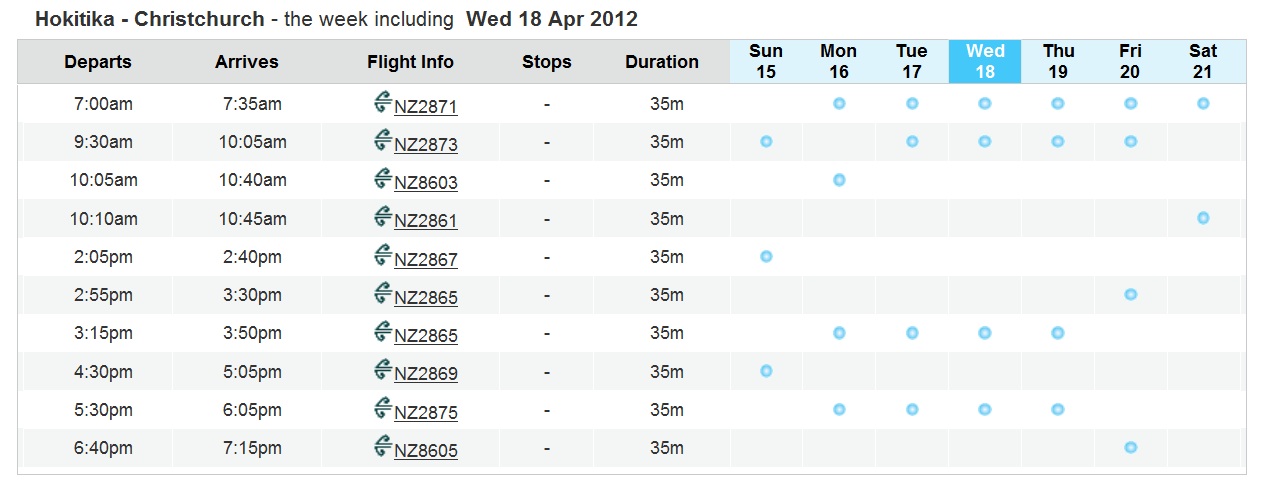
The Hokitika timetable for week of 15-21 April 2012. The 2000 series flights are operated by Eagle Air with Beech 1900s, the 8000 series flights are operated by Air Nelson with Bombardier Q300s.

By 2016 Eagle Air was operating two flights between Christchurch and Hokitika on Saturdays, three on Sundays and Mondays and four on Tuesdays to Fridays, with a Monday morning service and Friday evening service being operated by Air Nelson Bombardier Q300 service.

Air New Zealand's decision to withdraw the Beech 1900 fleet meant the end of the Eagle service to Hokitika. The final flights were flown on the 1st of May 2016 with Beech 1900 ZK-EAC flying the three return Hokitika-Christchurch services. The final flight out of Hokitika was flown by Tom McGeoch and Alister Dumbleton. A couple of hours later the final Christchurch to Hokitika flight was flown by Captains Chris Mortimore and Trent O'Shea before they positioned the Beech back to Hamilton ending Eagle Air's almost 14 year service to Hokitika. The following day Air Nelson took over all Air New Zealand's Hokitika services.

ZK-EAC at Hokitika before the first departure to Christchurch on the 1st of May 2016 
Tom McGeoch and Alister Dumbleton, the crew on the final flight to Christchurch

02 June 2012

Great Barrier Airlines Trislander Fire


About 12 people were evacuated from a small aircraft which caught fire at Auckland Airport this morning.  Emergency services were called to the airport at 8am after the Great Barrier Airlines aircraft's wheel brake caused the fire in the undercarriage. Great Barrier Airlines chief executive Mark Roberts said the plane was taxiing out when the pilot noticed the brake was binding.  "He turned back and as he took the aircraft back the brake overheated which caused smoke coming out of the undercarriage," he said.  "As he unloaded the passengers a small fire broke out, which he tried to extinguish with a fire extinguisher onboard the plane, but because of the heat the fire kept reigniting."  Fire fighters were able to extinguish the fire almost immediately after arriving on the scene, using dry powder. A police communications spokesman said earlier the plane was forced to make an emergency landing. All passengers were safely evacuated and caught a similar aircraft to Great Barrier Island and hour and a half later. Roberts said the incident was the first of its kind involving the airline's planes since he took over as chief executive in February.
Source : http://www.stuff.co.nz/national/7034792/Great-Barrier-bound-plane-catches-fire

01 June 2012

Plane Spotting at Incheon - 2

Part two of my plane spotting at Incheon waiting for my flight to Tel Aviv....


Korean Air's Boeing 777-200 HL-7575 at Incheon on 29 May 2012. Photo : S Lowe

Korean Air's Boeing 777-20  HL-7733, in Skyteam colours, at Incheon on 29 May 2012. Photo : S Lowe

Asiana Airlines' Airbus 330 HL-7740 at Incheon on 29 May 2012. Photo : S Lowe

Asiana Airlines' Airbus 320 HL-7772 at Incheon on 29 May 2012. Photo : S Lowe

Asiana Airlines' Boeing 767-300 HL-7516, in Star Alliance colours, at Incheon on 29 May 2012. Photo : S Lowe

Jeju Air's Boeing 737-800 HL-8239 at Incheon on 29 May 2012. Photo : S Lowe

Cathay Pacific's Airbus 330 B-LAC at Incheon on 29 May 2012. Photo : S Lowe