Freedom Air was launched on the 8th of November 1995 as a low cost charter operator to compete with Kiwi International Airlines which was operating flights across the Tasman from Hamilton and Dunedin. Freedom Air International was the trading name of South Pacific Air Charters Ltd, which was a wholly owned subsidiary of the Mount Cook Group and which in turn was a subsidiary of Air New Zealand.
 |
| The Mount Cook connection - on Freedom Air's first aircraft, Boeing 757 G-BYAF |
Freedom Air announced that it initially planned to operate charter services from Dunedin, Christchurch, Wellington Hamilton and Auckland to Sydney and Brisbane using a Boeing 757-200ER leased from Britannia Airways. Hamilton-based trans-Tasman airline Kiwi International saw this as direct competition from the Air New Zealand-owned Mount Cook Group. Kiwi International chief executive Ewan Wilson said, "It's a deliberate attempt by a huge, resourceful, existing operator to try and eliminate competition." Kiwi, at this time were offering low cost flights from Hamilton to Brisbane and Sydney and from Dunedin to Sydney.
Mount Cook Group public affairs manager, Allanah James, rejected this claiming Mount Cook had planned the move for some years. "Over the last three years we have identified a niche in the market for charters. We researched the market first but Kiwi got up and running in the meantime." She said the company would aim at budget travellers who had not been able to afford to fly overseas. Kiwi Travel has also focused on budget travellers with a no-frills service to Sydney which excludes meals and bar service, but Allanah James said the Mount Cook charters would be different and offer an alternative. Mount Cook Group general manager Peter Clark also rebutted the Kiwi's opinion saying, "No, we're not looking to see anybody off the patch. We're looking to develop a market and if we can grow the market we think there's going to be enough there for everybody."
So what was the real story. Certainly most of Kiwi's business came from individual travellers taking advantage of discount prices. It did not actively market itself to groups or offer add-on packages and tours. Freedom, however, was seeking to introduce broader package deals with air fares, accommodation and other add ons. Peter Clark said Mount Cook is already a well-established player in the charter and group tour market and it will be vigorously pursuing that market as well as the independent travellers. The company will also be looking to use Freedom to expand its business from Australian groups by putting together packages to bring them to New Zealand where they will link up with Mount Cook's existing tourism interests. The company has an established reservation system in Australia and a marketing unit in Sydney to develop opportunities there. "I think initially there are also broader opportunities to fly out of secondary airports in Australia," Mr Clark said, although he would not say which ones.
Freedom Air’s first timetable highlighted the “Freedom of Choice” the airline made available to help free people from the daily grind and giving them the opportunity to fly cheaply while sun logo reflected not only the sun and sea but also holidays. The freedom to just get up and go whenever the mood hits you is now all yours! With Freedom Air International - New Zealand’ newest airline – travel is finally, gloriously affordable! Freedom from work, freedom from winter, freedom to airscape to Australia from any of five destinations aboard a fun-filled charter flight at an affordable price!
Freedom Air’s impending arrival sparked a trans-Tasman airfare war. The standard economy fares to Sydney for both Freedom and Kiwi were $449 return which was the cheapest fares offered by Air New Zealand and Qantas. For that, on Kiwi you got nuts and cola - on Freedom you received a meal. A meal was additional on Kiwi and liquor was additional on both airlines. With the announcement of Freedom's advent Qantas lowered its fares to $395, with Air New Zealand following suit. Kiwi Air countered with a $200 return fare for those travelling with a companion. To make matters worse, in late November 1995 Auckland-based Pleasure Tours announced last week it would offer charter flights to Sydney and Brisbane under the New Zealand Trans banner from late January 1996.
In the initial timetable, flights were offered between Hamilton and Brisbane and return (on Saturdays), Auckland and Sydney (on Fridays and Mondays), Dunedin and Sydney (on Sundays), Hamilton and Sydney (on Mondays), Christchurch and Sydney (westbound on Wednesdays and eastbound on Thursdays) and Wellington and Sydney (eastbound on Wednesdays and westbound on Thursdays)
 |
| Freedom Air's initial timetable. As can be seen from the timetable, there was also quite a bit of aircraft positioning required - Late on a Saturday from Hamilton to Auckland, on a Sunday from Auckland to Dunedin, before Monday morning from Dunedin to Hamilton, on a Tuesday morning from Dunedin to Christchurch, and on a Wednesday from Christchurch to Auckland. Thursday was a maintenance day. |
On the 4th of December 1995 Boeing 757-200ER, G-BYAF, arrived in Auckland from UK-based Britannia Airways along with pilots, cabin crew and engineers . The Boeing 757 had a 235 seat all economy configuration. Freedom Air began operations on the 8th of December 1995 with G-BYAF operating the first Freedom Air flight, SJ940, from Auckland to Sydney with 56 passengers and the return flight, SJ941, from Sydney to Auckland.
 |
| Boeing 757 G-BYAF on approach to Christchurch on 27 December 1995. |
One feature of Freedom Air was how quickly it embraced innovation in regards to its reservation systems. From the beginning it used 0800 phone numbers for reservations. On the 18th of April 1996 it launched its Open Skies reservations system which made Freedom Air the first totally ticketless airline in the Pacific. Later, on the 15th of April 1998, it launched its own website, www.freedomair.com. On the 29th of March 1999, Freedom Air stopped paying travel agents commission on bookings, instead passing on savings to passengers. Further incentives were offered to encourage passengers to book through the airline’s internet site.
On the 26th of April 1996 the Boeing 757 flew its last Freedom Air services, a Hamilton-Brisbane-Hamilton return flight followed by a Hamilton-Sydney-Hamilton service. The aircraft the positioned to Auckland and returned to the UK the following day. The 757 was replaced with a Boeing 737-300, N371TA, which was leased from El Salvador based TACA International Airlines. The El Salvadorian Boeing was on an eight-month lease that included a TACA flight crew and engineers while Freedom Air supplied the cabin crew. It arrived in New Zealand on the 22nd of April 1996 and entered service on the 27th of April 1996 with a flight from Hamilton. This was the first Boeing 737-300 used in New Zealand.
 |
| The El Salvadorian Boeing 737-300 N371TA at Hamilton on 6 July 1996 |
Flights from Auckland, Wellington and Christchurch ceased on 26th of April 1996 in favour of a greater focus on flights from Hamilton and Dunedin and a new provincial port, Palmerston North, which was added to the network on 17th of May 1996. The 1996 winter timetable offered flights between Dunedin and Sydney (once a week), Dunedin and Brisbane (once a week), Hamilton and Brisbane (four times a week), Hamilton and Sydney (four times a week), Palmerston North and Brisbane (twice a week) and Palmerston North and Sydney (twice a week). All the flights from Palmerston North to Australia operated via Hamilton while one each of the flights from Brisbane and Sydney to Palmerston North were direct and then carried on to Hamilton and one from each Australian centre operated to Palmerston North via Hamilton.
 |
| Freedom Air timetable, winter 1996, NZ Herald |
During July 1996 a Polynesian Airlines Boeing 737 was leased to cover scheduled maintenance, and, as in the timetable above, also flew charter flights from Hamilton to Coolangatta and these turned out to be later the forerunner of a new scheduled service to the Gold Coast. Over the 1996-1997 summer Freedom Air leased Air New Zealand's Boeing 737-200 ZK-NAH on numerous occasions. The aircraft operated in a white scheme without titles.
 |
| On a Freedom Air service, fill in Boeing 737-200 ZK-NAH |
On the 11th of August 1996 Freedom Air International obtained its own Air Services Licence so changed from a charter airline to a scheduled airline. The following month Kiwi Air collapsed and this proved a real bonus for Freedom Air and markedly increased their loadings.
On the 4th of April 1997 the El Salvadorian Boeing 737 flew its last flights for Freedom Air, a return flight from Hamilton to Brisbane followed by a return flight from Hamilton to Sydney. The following day Freedom Air flew its first service in its own, albeit leased, Boeing 737-300, ZK-FDM. This aircraft, as well as being New Zealand registered, was all New Zealand crewed.
 |
Three shots of Freedom Air's Boeing 737-300 ZK-FDM...
At Christchurch in the initial colour scheme on the 25th of March 1997... |
 |
| With the full email address and repainted engine nacelles at Wellington on the 4th of June 2001 |
 |
| And with an abbreviated email address at Christchurch on the 1st of March 2005 |
Coolangatta was added as a destination during winter 1997 with connections initially to Palmerston North and Hamilton. Flights between the Gold Coast and Palmerston North were later dropped.
 |
| Freedom Air routes |
A Boeing 737, PH-TSX, was dry leased from Dutch airline Transavia and it saw service with Freedom Air from the 20th of February until the 29th of March 1999 while Freedom Air's Boeing 737 ZK-FDM was being repainted. PH-TSX was later to return to New Zealand and become ZK-NGK with Air New Zealand.
 |
| The Dutch Boeing 737 PH-TSX with Freedom Air titles at Christchurch on the 19th of February 1999 |
On the 20th of November 1999 a second Boeing 737-300, ZK-FRE, arrived on delivery to Freedom Air. The new 737 was repainted in Freedom Air colours and entered service on the 6th of December 1999. The arrival of the new 737 freed ZK-FDM for its own checks and then enabled a two aircraft schedule to begin from the 15th of December. To facilitate the increased schedule Freedom employed a further 12 pilots and 20 cabin crew.
The second Boeing 737 also enabled new routes. Melbourne was added to the network on the 15th of December 1999 with connections to Palmerston North and Hamilton. Also in December 1999 flights were introduced between Palmerston North and Coolangata. On the 29th of March 2000 Freedom Air began services to Fiji when it introduced a twice weekly service between Palmerston North and Nadi. The first flights, northbound to Nadi (SJ431) and southbound (SJ432) were operated by ZK-FRE.

During winter 2000 Freedom Air was operating a busy schedule. From Hamilton there were five flights a week to Brisbane, two flights a week to the Gold Coast, three flights a week to Sydney and two flights a week to Melbourne. From Dunedin there were twice weekly services to both Brisbane and Sydney. From Palmerston North there was a weekly service to the Gold Coast and two flights a week were offered to Brisbane, Sydney, Melbourne and Nadi. The service to Fiji was, however, short-lived due to the coup attempt by George Speight against the Mahendra Chaudhry government. The ensuing political unrest and resulting drop in demand led to the Wednesday service ceasing on the 5th of July 2000 and all services finally ceasing on the 29th of July 2000.
There was a change of Boeing 737s in 2000, with Boeing 737-300 ZK-SJB entering service with Freedom Air on the 16th of August 2000 replacing Boeing 737-300 ZK-FRE that was transferred to Air New Zealand.
In April 2001 Qantas New Zealand collapsed. Eleven days later, on the 1st of May 2001, Freedom Air introduced domestic passenger services within New Zealand between Auckland, Wellington and Christchurch. The first domestic services were operated by ZK-FDM. The inaugural flights featured a live jazz band and passengers were given sunflowers, free water, bananas and yellow jellybeans. With the sudden entry to the domestic market only 350 seats were booked on all of Freedom's six inaugural flights between Auckland, Wellington and Christchurch. Two of the six legs had fewer than 10 bookings.
The domestic service meant more aircraft were needed and a Boeing 737-200QC, ZK-NQC, was leased from Airwork NZ and joined the fleet on the 2nd of May 2001 branded with freedomair.com titles. While NQC operated day time flights with Freedom Air at night it operated its normal courier post flights for NZ Post. ZK-FDM was also used to operate domestic services. To replace it Polynesian Airlines' Boeing 737-300 5W-ILF was leased and branded with freedomair.com to operate international services with Boeing 737-300 ZK-SJB.
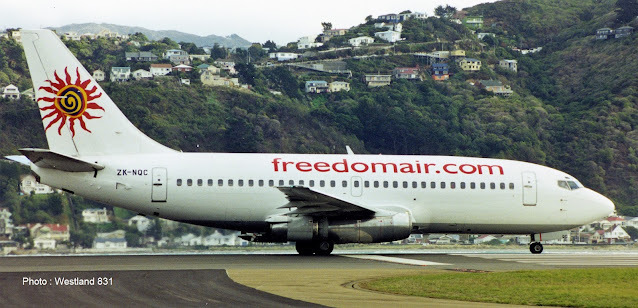 |
| Operating a domestic service, Boeing 737-200 ZK-NQC at Wellington on 4 June 2001 |
 |
| Leased from Samoa's Polynesian Airlines, Boeing 737-300 5W-ILF with Freedom Air titles at Palmerston North in August 2001 |
Despite the rapid entry numbers soon picked up. In the first three weeks of domestic operations 10,000 passengers had been carried and 28,474 people had booked domestic flights on the airline. Wayne Dodge, Freedom Air’s vice president and general manager, said the response from New Zealanders had been fantastic. “The level of interest in flying on Freedom Air has demonstrated that Kiwis were crying out for a value-based domestic service.”
5W-ILF was with Freedom Air until the 3rd of August 2001 and with its withdrawal there was a temporary reduction in domestic services.
On the 1st of October 2001 Boeing 737-300 ZK-SJC entered service with Freedom Air, the first in the fleet to display the new yellow colour scheme. SJC was followed by ZK-SJE entering the fleet on the 9th of November 2001 and this enabled the resumption of the two aircraft domestic services.
 |
| The first Boeing 737-300 in Freedom Air's yellow scheme, ZK-SJC on approach to Christchurch on 12 April 2005 |
On the 13th of November 2001 Freedom Air reintroduced international services from Auckland with flights to Coolangatta commencing the on 13th of November 2001 and to Newcastle on the 15th of December 2001. ZK-SJE operated the first flights to both Australian centres. When these new services were announced, Wayne Dodge, Freedom Air's vice-president/general manager, said the new routes demonstrate the strength of Freedom Air’s business. “Freedom Air is growing rapidly, proving there is strong demand for value-based air services,” he says. “These new routes will make trans-Tasman travel significantly more convenient for a large number of travellers, saving them both time and money and giving them more scope to enjoy their leisure holiday time. We believe this is the prime time to develop new routes out of Auckland, given the size of the market and the success of our provincial flights to Australia. Freedom Air also acknowledges the enormous contribution of state governments, businesses, local operators and tourism boards in both new Australian destinations in facilitating these new routes.” The Newcastle service did not meet projected expectations and it ended in 2002.
A new service between Dunedin and the Gold Coast commenced on the 27th of March 2002.
In July 2002 Air New Zealand announced that Freedom Air would withdraw from domestic services on the 22nd of September 2002 and that Air New Zealand would fill the budget role with the parent company promising it would match the popular cheap fares with its new no-frills service. At the same time Air Zealand would withdraw from 11 Australian flights and in turn Freedom Air would introduce another 16 extra Queensland flights.
On the 22nd of September, Freedom's last domestic flights were operated by Boeing 737s ZK-FDM and ZK-SJB. ZK-SJB operated the final Freedom Air domestic flight, SJ92, from Christchurch to Wellington and Auckland.
On the 4th of October 2002 South Pacific Air Charters Ltd, that had traded as Freedom Air International, was renamed Freedom Air Ltd.
From the 27th of October 2002 Freedom Air commenced its expanded trans-Tasman schedule. New routes were added from Brisbane to Auckland (three times a week), to Wellington (six times a week) and to Christchurch (daily), Freedom Air thereby replacing all Air New Zealand flights from Christchurch and Wellington to Brisbane. Freedom Air also introduced a Christchurch to the Gold Coast service (three times a week) while the Palmerston North-Gold Coast service was withdrawn. The fleet at this stage consisted of four Boeing 737-300s, ZK-FDM, ZK-SJB, ZK-SJC and ZK-SJE.
Freedom Air returned to Fiji in 2004 with flights from three New Zealand cities. In a press release Michael Young, Freedom Air’s acting General Manager, said the Nadi service represents the first of a number of possible new routes for the no-frills airline. “We have been working on new route opportunities for the past eight months and believe Fiji has a lot of potential for us. “We will continue to evaluate other possible new routes as part of our commitment to providing New Zealanders the opportunity to travel to more exciting destinations more often.” Services began from Hamilton on the 29th of April, Christchurch on the 13th of May, Palmerston North on the 15th of May 2004, and following the uptake of the flights from these three centres, from Wellington on the 11th of February 2005.
On the 13th of September 2004 Freedom Air's fifth Boeing 737-300, ZK-NGA, entered service having been transferred from parent company Air New Zealand.
 |
| About to roll, Freedom Air Boeing 737-300 ZK-NGA at Christchurch on 1 May 2005 |
In late 2004 Freedom Air announced that it would expand the number of flights from Christchurch to the Gold Coast from three to five per week and from Wellington to Brisbane from five to seven per week. Freedom Air’s sales and marketing manager, Rachel Gardiner, said the extension to its scheduled services between Queensland and Wellington and Christchurch are in direct response to demand from people wishing to fly Freedom. “In the past 12 months, we have seen passenger numbers increase by between 63 and 70 per cent on these routes." The airline also announced that from the 2nd of April 2005 it would operate weekly flights began from Wellington to the Gold Coast adding to the flights Freedom Air already operated to the Gold Coast from Auckland, Hamilton, Christchurch and Dunedin.
2005 was a year of strengthening, rationalising and new beginnings. Services to and from Sydney were strengthened, with Dunedin receiving three flights each week and Hamilton five each week. Realising that they were competing against themselves Air New Zealand and Freedom Air rationalised air services on the 25th of April 2005 by no longer overlapping service on the same routes, thus avoiding any duplication. The changes saw Air New Zealand take over the operation of all the flights from Auckland, Wellington and Christchurch to Brisbane and Freedom Air took over all services between Wellington and Nadi. Accordingly Boeing 737 ZK-NGA was withdrawn from the Freedom Air fleet, operating its last services on the 24th of April 2005.
Freedom Air's big news for 2005, however, was the replacement of the Boeing 737 fleet with Airbus 320s. The first of four, ZK-OJK, arrived in Auckland on the 4th of June 2005. General Manager Stephen Jones said, "The arrival of the Airbus represents a redefining of Freedom Air in the market as we look to new challenges and opportunities. It demonstrates the confidence of our parent company, Air New Zealand, in our business and allows us to express that confidence to our passengers. Having a fleet of the newest aircraft in the country will go a long way to help us meet our goals of continued improved service records while we strive to maintain our ongoing commitment to low prices and flying the services and frequency our customers want." The Airbus entered service on the 8th of June operating from Hamilton to Nadi (SJ732) before operating a return service to Wellington (SJ916/915) and then returning back to Hamilton (SJ731).
 |
| Freedom Air's first Airbus 320, ZK-OJK, on approach to Christchurch on 21 June 2005 |
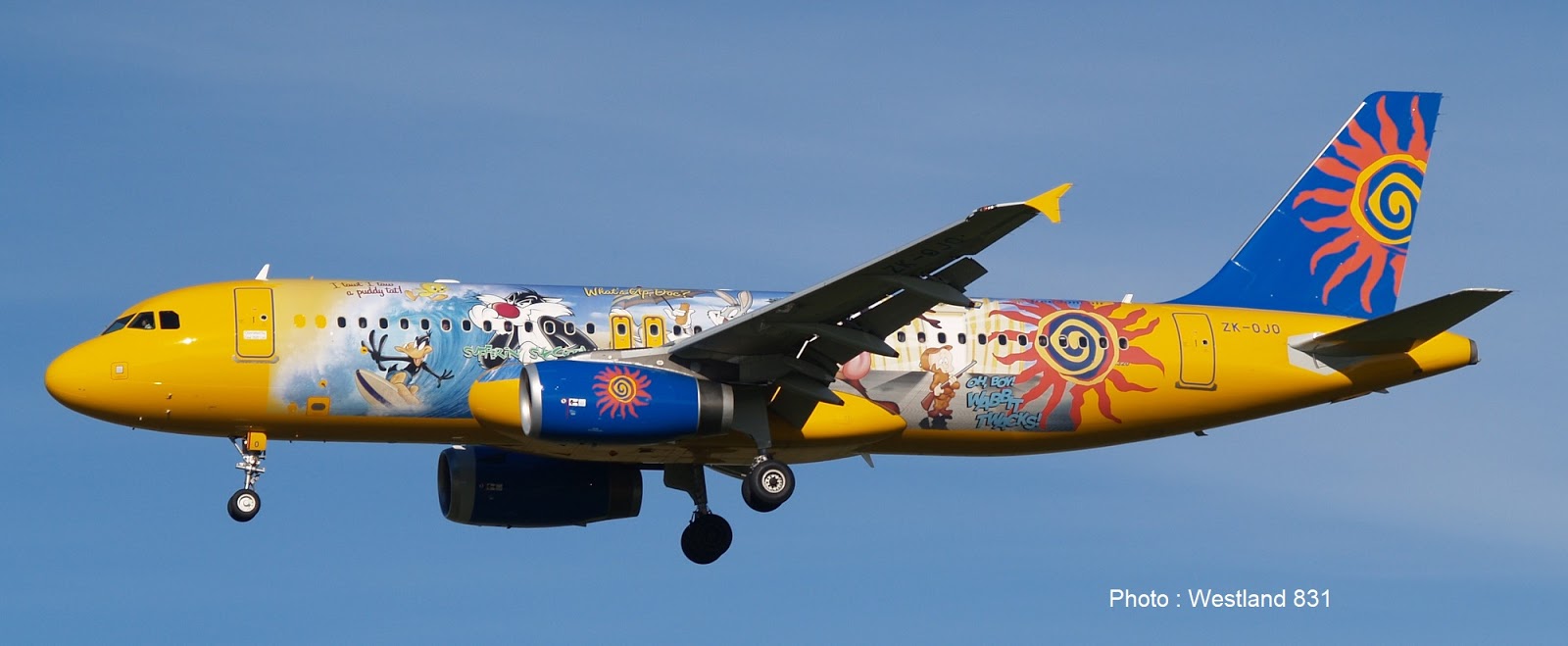
The second Airbus, ZK-OJL featured a "holiday" theme, the result of an 'Art in the Sky' competition held jointly between Freedom Air and Warner Bros Movie World. The competition was won by 17 year old art student Ché Ridland from New Plymouth. It entered service on the 5th of August 2005. ZK-OJO entered service on the 4th of February 2006 and in May 2006, like ZK-OJL, it received the Warner Bros decals. Only these three Airbus 320s, ZK-OJK, ZK-OJL, and ZK-OJO, were painted in Freedom Air colours.
However, Freedom Air also used other Airbus 320s. Of these two, ZK-OJM and ZK-OJN, were both registered to Freedom Air and operated in the standard Air New Zealand colour scheme. ZK-OJM first entered service with Air New Zealand before entering service with Freedom Air on the 16th of October 2005. It operated with Freedom until early February 2006. ZK-OJN entered service with Freedom Air on the 8th of December 2005.
In 2006 Air New Zealand established a new company, Zeal 320 Ltd, to manage the Freedom and Air New Zealand Airbus 320 fleet. All flight and cabin crew came under the Zeal 320 banner and this allowed them to operate services for either airline. Prior to this Air New Zealand crew couldn't operate Freedom services and vice versa. Zeal 320 received its own aircraft operating certificate and this enabled the airlines to reduce their combined fleet by two Airbus 320s.
This meant Freedom Air's services were often flown by aircraft in full Air New Zealand colours. The following Airbus 320s were registered to Zeal 320 on the dates shown and were operated jointly by Air New Zealand and Freedom Air; ZK-OJA on the 23rd of May 2006, ZK-OJB on the 21st of June 2006, ZK-OJC on the 18th of July 2006, ZK-OJD on the 15th of August 2006, ZK-OJE on the 24th of April 2006, ZK-OJF on the 21st of June 2006, ZK-OJG on the 6th of December 2006, ZK-OJI on the 7th of June 2006. In addition to these, the two Airbuses registered to Freedom Air and wearing Air New Zealand colours became part of the Zeal 320 operation, ZK-OJM on the 12th of June 2006 and ZK-OJN on the 26th of June 2006
As the Airbus 320s were added to the fleet the Boeing 737s were withdrawn during the second half of 2005. ZK-SJC operated its last Freedom Air service on the 7th of June, ZK-SJE on the 7th of August, ZK-FDM on the 15th of October and the last 737 to leave the fleet, ZK-SJB, was withdrawn from Freedom Air service on the 29th of October 2005.
The introduction of Airbus 320s enabled Freedom Air to introduce Suite Seats. Freedom Air’s General Manager, Stephen Jones, “While our core market will always be leisure travellers, we’ve been looking closely at our fleet scheduling for popular business routes to ensure we’re flying at the times that suit these travellers. And it’s great to have the new Suite Seats, which are eight, bigger, leather upholstered 40” pitch seats in all of our aircraft. This new seating options caters for those who want a little more room in flight – ideal for the business traveller and those who want a little more luxury.”
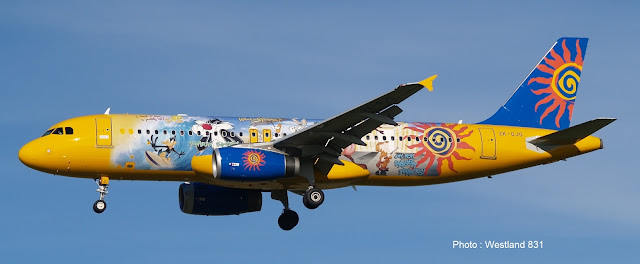 |
| Wearing the Warner Bros decals designed by Ché Ridland, Airbus 320 ZK-OJO is seen on approach to Christchurch on 17 August 2006 |
In December 2005 Freedom Air celebrated ten years of bringing cheaper and more accessible air travel to Kiwis." During those ten years Freedom Air flew more than 3,260,000 passengers between its various ports. About two thirds of these passengers were New Zealand holiday makers and Australians largely accounted for the remaining third with some Fijian travellers. Freedom Air’s General Manager, Stephen Jones, said, celebrating ten years is a significant milestone which underlines Freedom’s position as a major player in the highly competitive trans-Tasman market. “It’s great to be 10. We thrive in this dynamic market, we know the New Zealand traveller well and as our passengers will tell you – there’s something inherently Kiwi about travelling with our airline. By providing that experience, Freedom Air plays a very important role in the Air New Zealand group – offering a low cost, family-friendly travel option, as well as more accessibility for all Kiwi travellers.”
 |
| Palmerston North's international connections with Freedom Air |
As the trans-Tasman market became more competitive Melbourne, which was under-performing, was dropped from the Freedom Air network in March 2006 meaning the loss of connections with Hamilton, Palmerston North and Dunedin. This caused some angst from the provincial centres and just weeks after dropping the services Freedom Air announced it would resume services to Melbourne from Hamilton, Palmerston North and Dunedin seasonally during the summer season (late October - late March) "when New Zealanders traditionally head across the ditch to visit friends and relatives or seek guaranteed warmer weather. This is also the peak time for Kiwis living in Australia to travel home to be with friends and family." Freedom Air General Manager, Stephen Jones, said, "People were very disappointed when we came off Melbourne but for Freedom it was a sensible business decision as the route was losing money. It's quite simple - people need to use the services if they want to maintain them." To facilitate the re-introduction of Melbourne services, the airline reviewed its existing route structure. Fiji services from Hamilton and Palmerston North were not performing well over the summer months as more people travelled to the Pacific during winter. So for Palmerston North and Hamilton, Freedom Air moved to seasonal schedules that interchanged between Melbourne in the summer and Fiji in the winter seasons. The Wellington to Fiji route was also withdrawn over the New Zealand summer months.
The airline later announced that it would discontinue its services to Nadi from Hamilton, Palmerston North and Christchurch from March 2007. Freedom Air said these routes had been under-utilised, and the decision was made to restructure the business towards a focus on its popular Australian routes. The seasonal Wellington-Nadi service remained.
However, the biggest cut of all was coming. On the 6th of September 2007 Air New Zealand announced an overhaul to its trans-Tasman and Pacific services. Air New Zealand's Group General Manager - Short Haul Airlines, Norm Thompson, said, Over the next 18 months, Air New Zealand will progressively introduce changes including a more spacious section of economy seating, new state-of-the art in-flight entertainment services and new food and beverage menus. Mr Thompson also said that from 30 March 2008 Air New Zealand services would replace Freedom Air services on the Tasman, to provide customers with a more consistent and higher quality travel service. “Customers flying the Tasman today have a range of experiences depending on which of our airlines they are flying, and which aircraft they’re travelling on. We are realigning our services so that customers know what to expect - and have that expectation met - at every step of their journey.” Freedom Air has been operating for more than 10 years and Mr Thompson said it had provided more than four million Kiwis and Australians with a great low-cost travel option during that time. “The reality is that the price of airfares has fallen dramatically over the past ten years, and today there is little difference between Freedom and Air New Zealand fares.” Mr Thompson said customers surveyed had emphasised the need for an improved food offering, more leg-room and in-flight entertainment choices while maintaining Air New Zealand’s competitive pricing. Mr Thompson said as part of the Tasman review Freedom Air’s direct services to and from Palmerston North to Sydney and Brisbane would be suspended from 30 March 2008.
On the final day of services, the 30th of March 2008, ZK-OJB operated a Brisbane to Dunedin return service (SJ376/SJ379), ZK-OJD operated Palmerston North to Sydney (SJ735), Palmerston North's last scheduled international service, ZK-OJG operated a return service from Christchurch to Sydney Coolangatta (SJ965/SJ966), ZK-OJN operated a return service from Auckland to Coolangatta (SJ907/(SJ908), and ZK-OJO operated from Hamilton to Coolangatta (SJ925) and then on to Wellington (SJ942). At this time ZK-OJO was the only Airbus wearing Freedom Air colours. The honour of flying the last Freedom Air flight fell to ZK-OJM which operated from Wellington to Coolangatta (SJ943) and then the last Freedom Air flight, from Coolangatta to Hamilton (SJ928) under the command of Captain John Harvey and First Officer Nigel Hoggard.
Freedom Air started out as a pawn in the trans-Tasman air wars. Unlike Kiwi, it was backed by a major player in the form of parent company Air New Zealand. In the years of its operation it taught Air New Zealand a lot about the changing dynamics of the travelling public and this led to many innovations that enabled Air New Zealand to survive as a national carrier but still offer the freedom for Kiwis to have available to them package deals and affordable holidays.
The big losers were undoubtedly Kiwi Air, Hamilton, Palmerston North and to a lesser extent Dunedin. Would Kiwi Air have survived had Freedom Air not entered the market? I'm not sure. It certainly proved there was a market there and Ewan Wilson and his team had an abundance of vision and enthusiasm. But vision and enthusiasm is not enough. Running an airline is a sophisticated business that requires robust structures to support it and a strong capital base underpinning it. Kiwi Air had neither, it was starting from scratch and it was always just a phone ahead of the bank and creditors.
But Kiwi Air and Freedom did show that provincial centres, and Hamilton, in particular could sustain international air services. However, the trans-Tasman air war that continues to this is being fought in the main centres and new comer Queenstown. The battles have moved away from the provincial centres, centres which often have visions of grandeur that are not realistic. Nonetheless, there is still a market there, and who knows, will Hamilton and Palmerston North one day regain international services?
Freedom Air ushered Air New Zealand towards new concepts of trans-Tasman travel and ushered New Zealanders towards new holiday options and the great airscape continues today albeit on other airlines.
Fleet
Boeing 757-200
G-BYAF - Boeing 757-204 (c/n 26266)
Boeing 737-200
ZK-NAH - Boeing 737-2Y5 (c/n 23039)
ZK-NQC - Boeing 737-219QC (c/n 22994)
Boeing 737-300
5W-ILF - Boeing 737-3Q8 (c/n 26282)
N371TA - Boeing 737-3S1 (c/n 24834)
PH-TSX - Boeing 737-3K2 (c/n 26318)
ZK-FDM - Boeing 737-3M8 (c/n 25016)
ZK-FRE - Boeing 737-3U3 (c/n 28742)
ZK-NGA - Boeing 737-33R (c/n 28873)
ZK-SJB - Boeing 737-33R (c/n 28868)
ZK-SJC - Boeing 737-3U3 (c/n 28738)
ZK-SJE - Boeing 737-3K2 (c/n 27635)
Airbus 320 – Operated in Freedom Air colours
ZK-OJK - Airbus A320-232 (c/n 2445)
ZK-OJL - Airbus A320-232 (c/n 2500)
ZK-OJO - Airbus A320-232 (c/n 2663)
Airbus 320 – Not operated in Freedom Air colours
ZK-OJA - Airbus A320-232 (c/n 2085)
ZK-OJB - Airbus A320-232 (c/n 2090)
ZK-OJC - Airbus A320-232 (c/n 2112)
ZK-OJD - Airbus A320-232 (c/n 2130)
ZK-OJE - Airbus A320-232 (c/n 2148)
ZK-OJF - Airbus A320-232 (c/n 2153)
ZK-OJH - Airbus A320-232( c/n 2157)
ZK-OJI - Airbus A320-232 (c/n 2297)
ZK-OJM - Airbus A320-232 (c/n 2533)
ZK-OJN - Airbus A320-232 (c/n 2112)
In putting together these airline profiles I am often indebted to the work of others. The information is often out there but not brought together and this is what these airline profiles aim to do. For this post I am particularly grateful for the archives of Bruce Gavin, the work of Mike Condon and Phil Craig published in the AHSNZ Aerolog and Paul Sheehan for his work, Air New Zealand Aircraft - 75 Years, on the aircraft Air New Zealand and its subsidiaries have operated




.jpg)