12 September 2011

Auckland's Jet Fest...

Wayne Grant had a ripper of a day catching up with international and domestic jet movements through Auckland on Saturday including Singapore Airlines, Air National (or should it be Vincent Aviation?), DHL, Thai, Air New Zealand, China Southern, Qantas, Jetstar and Air Vanuatu.

All photos were taken at Auckland on 10 September 2011 by Wayne Grant


11 September 2011

Ardmore Air Charter - Simply the Best Way to Fly to the Barrier


Ardmore Air Charter was an off shoot of the Ardmore Flying School, which was owned and directed by Liz Needham and Pete Roe. In September 1984 the Auckland Aero Club's NZ Air Charter withdrew its service to and from both Ardmore and Mangere and Great Barrier Island. Responding to a need perceived by some islanders Ardmore Air Charter introduced a twice daily Ardmore-Great Barrier Island "no frills, professional service.”


Initially Partenavia P68B ZK-LAL (c/n 70) was used for the service with the Ardmore Flying School's other twin-engined aircraft being used for backup.

Ardmore Air Services Partenavia P68B, ZK-LAL, taken at Ardmore.

From December 1984, in an attempt to keep fares down in the face of increasing fuel prices, the company, while preferring to use twin-engined aircraft, also used single-engined aircraft on the route. At this stage it as also announced that all flights would operate on a demand basis with a minimum of two confirmed full fares required.

One of many single engined aircraft Ardmore Air Charter operated, Cessna 172 ZK-EJQ at Ardmore on 23 May 1988.

The service initially looked quite promising, however, the business did not grow. The service was last advertised in the Barrier Bulletin in the June July issue of 1985 and in the Southern Cross Airways timetable of 28 October 1985. The service presumably ended at the same time as the Southern Cross Airways service in either late 1985 or early 1986.

An advertising comparison... In the NZ Herald on 1 June 1985, and...
...the last advert in the Barrier Bulletin, while it was still being produced on a Gestetner machine, in June-July 1985. 
The last advertising of the service, in the Southern Cross Airways timetable of 28 October 1985.

10 September 2011

A Lucky Shot

Captured through the window of my Great Barrier Airlines flight from Great Barrier to North Shore and Auckland was New Zealand's newest Piper Aztec ZK-FVP. By the time the Islander shut down the cover was on! The Aztec is registered to CBC Aviation of Whitianga. Photo taken at North Shore on 7 September 2011 by S Lowe

09 September 2011

Manapouri Whisper 2

TV3 captured Te Anau/Manapouri airport entering the jet age...

http://www.3news.co.nz/Te-Anaus-multimillion-dollar-airport-upgrade/tabid/317/articleID/224882/Default.aspx

Scheduled Flyers to the Barrier

During my visit to Great Barrier Island I managed to catch some of Great Barrier Airlines and Fly My Sky's fleet as they flew in and out...

Last flight of the day... Fly My Sky's BN Islander ZK-DLA taxis out at Claris bound for Auckland. Photo taken at Claris on 5 September 2011 by S Lowe
My ride over to the Barrier, Great Barrier Airline's BN Trislander ZK-LGF. Photo taken at Claris on 5 September 2011 by S Lowe
The light is not flash at Claris and I found myself usually shooting against the sun - Fly My Sky's ZK-SFK waiting for its next trip to Auckland. Photo taken at Claris on 5 September 2011 by S Lowe
Great Barrier Airlines were operating their Islanders to and from both Auckland and North Shore. Here ZK-FVD departs the Barrier for North Shore. Photo taken at Claris on 6 September 2011 by S Lowe
My ride home... Great Barrier Airlines' Islander ZK-REA. Photo taken at Claris on 7 September 2011 by S Lowe

08 September 2011

NAAG Fly in to Great Barrier Island

The Northern Adventure Aviation Group had a fly-in to Great Barrier Island's Claris Airport yesterday...

Over from Katikati was Europa XS ZK-CHV. Photo taken at Claris on 7 September 2011 by S Lowe 
The oldest member of the group was Jodel D.11 ZK-DJQ from Whangarei. Photo taken at Claris on 7 September 2011 by S Lowe 
Aptly registered is Flight Design CTLS ZK-FTC from Wellsford. Photo taken at Claris on 7 September 2011 by S Lowe 

Two Tecnam P96 Golfs were in attendance. Above, ZK-JAN came over from Waihi Beach. Below, ZK-RNJ came over from Ardmore. Photos taken at Claris on 7 September 2011 by S Lowe 


Aero Designs Pulsar XL has the registration ZK-KFC... is it advertising something??? I have since been told the letters were originally chosen for Katikati Flying Club  Photo taken at Claris on 7 September 2011 by S Lowe 

Alpi Aviation Pioneer 300 ZK-LPX taxis for home. Photo taken at Claris on 7 September 2011 by S Lowe 
SG Aviation Storm 300 ZK-VEE about to head home to Katikati. Photo taken at Claris on 7 September 2011 by S Lowe
Tecnam P2002 Sierra ZK-WBF obligingly taxies past my camera. Photo taken at Claris on 7 September 2011 by S Lowe 
Dyn Aero MCRO1 Club ZK-WIK is slightly different on both sides... Photos taken at Claris on 7 September 2011 by S Lowe 
 

Czech Aircraft Works Sportcruiser ZK-MBD is registered to a Whangamata owner. Photo taken at Claris on 7 September 2011 by S Lowe


The only known homebuilt/mircolight type was classic Cessna 172 ZK-CAA. Photo taken at Claris on 7 September 2011 by S Lowe 


Meanwhile aA couple of extras also flitted by...

A couple of more modern 172s from the Ardmore Flying School did a touch and go on cross countries - Above, ZK-EOX and below, ZK-TAQ. Photos taken at Claris on 7 September 2011 by S Lowe


07 September 2011

Paraparaumu "Beach" Terminal

The first thing passengers flying in to Kapiti on the new Air New Zealand flight service will see when they disembark is an old wooden sign stating "sorry, gone fishing". A quirky new Kapiti Coast Airport terminal featuring a coastal beach theme will greet passengers when the flight service between Paraparaumu and Auckland takes off over Labour weekend. Man-made sand dunes planted with native flaxes are included in the grounds surrounding the $1 million terminal and the beach theme continues inside with straw umbrellas, outdoor barbecue-type furniture and a realistic looking boardwalk, actually made of carpet. Airport owner Sir Noel Robinson said he wanted to create the beachy, relaxed atmosphere of the Kapiti Coast. "We wanted people to walk in and end up with a smile on their face. It does not look like an ordinary terminal - it is a Clayton's terminal. It is like you have come to the beach with deck chairs with soft canvas seating." Historic photographs on one wall recall the days last century when the National Airways Corporation flew to Paraparaumu, including one of Queen Elizabeth II stepping onto the tarmac. The toilets - designed by Dave Smithson of Home Creators and interior designer Heather Thorley - resemble old beachside loos. A cafe named "iland" will probably open a couple of days before the flights commence, Sir Noel said. Check-in counters have been installed for Air New Zealand and local flight service air-2-there. A seven-metre-long photo of Kapiti Island is featured on one one wall and old wooden aeroplane propellers enhance the historic aviation theme accompanying the beachside ambience. Named Terminal 1, it is located on the north-west side of the airfield with access from Toru Rd. A larger terminal was planned at a later date. The new flight service, using 50-seater turbo props, will take off on October 25.

Sounds Air add yet another flight


Sounds Air are to operate an extra Wellington - Blenheim return flight every Sunday afternoon from the 25th of September 2011. The flight will depart from Wellington at 3:45 p.m. and Blenheim at 4:30 p.m.

New Floatplane Operator?

Commercial floatplane ops for Queenstown
Further to an earlier Otago Daily Times report, a commercial floatplane operation first mooted two years ago has now been publicly notified, with submissions closing 29SEP11. Brent Collins, originally of Blenheim, applied for land use consent in 2009 to establish the new tourism venture on Lake Wakatipu, which would take people on sightseeing trips primarily from Queenstown to Glenorchy, but which would also include charter trips to Lake Wanaka and Lake Hawea. Consent was also sought for two planes, although initially only one would be used. It was intended to use a de Havilland Beaver DHC-2) with a three-bladed prop and/or a Cessna 206 (non turbo). A DHC-2 model could carry a pilot and seven passengers, while the C206 had capacity for a pilot and five passengers. The aircraft would have deployable wheels, allowing aircraft storage at Queenstown Aircraft premises overnight and on non-flying days. After consultation with authorities and local tourism operators, Mr Collins intends locating a floatplane pontoon well away from downtown, on the Queenstown Gardens side of Queenstown Bay, with passengers ferried by water taxi. A secondary runway would be located at Frankton Arm, for use if weather conditions within Queenstown Bay were unsuitable. Flights would operate on a year-round basis, with the frequency of trips determined by seasonal variations and weather conditions. The maximum number of flights per day for the operation of two planes is 16 flights over winter months and 22 flights over summer months.

05 September 2011

Manapouri Whisper

A multimillion-dollar investment in the new Fiordland airport is starting to pay off, with the first Whisper jet scheduled to taxi down the runway this week. Te Anau-Manapouri Airport manager Evan Pearce said yesterday a 118-passenger aircraft, the only one of its kind in New Zealand, was "99.9 per cent certain" to land at the airport on Wednesday. The plane, being brought into the area by tourist operator Tauck Tours, was the first of its kind scheduled to land at the airport since the $7.1 million-dollar upgrade in 2008. The upgrade had been developed specifically to attract larger aircraft such as the Whisper jet to the area, Mr Pearce said. "We've been working on this thing for the past 18 or so months, so this is very significant for Te Anau and Fiordland." The Southland District Council-owned airport hoped to eventually attract up to 52 landings from similar-sized aircraft each year, and next week's arrival was just the beginning, he said. "What this really means is it paves the way for further jet transport or further larger aircraft movements into Fiordland ... people's ears prick up and they say, `well, maybe we can do it, too'." Since the upgrade, the airport had also confirmed overnight excursions with tourist operators, which were expected to begin in January. That meant there was even greater potential for those in the tourism industry in Fiordland to capitalise on visitors to the area, Mr Pearce said. Destination Fiordland manager Lisa Sadler said the arrival of the Whisper jet this week was likely to be the beginning of a greater number of large aircraft opting to land in the area, rather than heading to other parts of the country, such as Queenstown. Although it was difficult to say how much money could be garnered from tourists flying into the area in the future, the arrival of a greater number of larger aircraft would eventually have a payback for the community, she said. It was expected that visitors on overnight trips would spend more money on accommodation, at restaurants, going on extra excursions and in retail outlets. "It's like people say – it's not going to happen overnight, but it will happen." The airport upgrade was a contentious issue for the council, with debate surrounding the development since its beginning.

04 September 2011

Gulf Island Air - Transfer Flights from Waiheke


When Flightline Aviation opened Waiheke Island’s Stonyridge Airstrip to general use in November 1992 one of the first operators to use the strip was locally owned Gulf Island Air. This company was formed by George and Janet Richardson who owned the land the on which Stonyridge airstrip was situated and their Piper Pa28-180 Cherokee ZK-SNE. (c/n 28-1509). In the March 2021 issue of Aviation News Geroge Richardson recounted how he taught students to fly off the Stonyridge airstrip, but the challenges of the airstrip meant that they went to Thames for their first solo flights. Flight training was Gulf Island Air's primary role. 

Great Barrier Airlines had found the strip was unsuitable for their aircraft and so for a time Gulf Island Air was contracted to maintain Great Barrier Airline's service to Auckland and Great Barrier Island with its four-seater Cherokee.
 
The only time I photographed Piper Cherokee ZK-SNE was at Matamata on 20 May 1988, four years before it was used for operations with Gulf Island Air.
 
 
Gulf News, 6 November 1992

In July 1993 Gulf Island Air added Piper Pa32-260 Cherokee 6 ZK-DDF (c/n 32-1509) to its fleet. This aircraft received a STOL kit to enable it to use the short Stonyridge strip. The connection with Great Barrier Airlines soon faded however the company continued to operate transfer flights to Auckland, Great Barrier Islands and other destinations in the Gulf as required in its own right.

Again, before being used by Gulf Island Air, Piper Cherokee Six ZK-DDF at Tauranga on 2 February 1992.

On the 22nd of December 1994 the Cherokee Six had an accident while landing at Stonyridge in cross-wind conditions with a nose wheel mounting failing on touchdown. George Richardson describes the incident... I did a scenic flight around Waiheke Island in SNE. It was blustery day with the wind being up to 35kt from the northwest with all the associated mechanical turbulence when down low, below 1000ft. I received a phone call to go to Auckland Airport and pick up two passengers from Auckland to be taken to Waiheke Island. Great Barrier Airlines considered the conditions too rough for its pilots. I went over to NZAA and picked up the passengers and returned to Waiheke. On final to land I hit some severe turbulence that was at the limit of the Cherokee 6 that I was flying, and just as I went to flare for landing on the uphill slope, I ran into a savage windshear. I had a reasonable amount of power on as I hit this shear, and I went to full power but couldn’t arrest the rate of descent and the Cherokee Six hit hard. I distinctly remember thinking this will be a hard one but it should be OK. The crosswind was about 15kt, so there was a fair amount of right rudder applied and left wing down for the touchdown. On contact with the ground the nose-wheel snapped off and the propeller struck the ground and folded around the engine cowling. DDF skidded on its nose for about 100ft and came to a halt. I opened the door and advised the passengers to get out NOW, which they did. I sat in the cockpit and proceeded to make a logbook entry to the bent prop, when one of the passengers came back and said I had better get out because there was fuel everywhere. I exited DDF very quickly, and to my astonishment I discovered that both wings had fractured at the aileron interface so that one wing tip tank was on the ground and spilling fuel. George told the Gulf News that one of the passengers had said, “It was better than his last flight in a small plane. That time he ended up upside down."

A rather forlorn looking Piper Cherokee 6 ZK-DDF on the Stonyridge strip on the 30th of December 1994. Photo : Gulf News

Gulf News 30 November 1994


The Cherokee ZK-SNE was still serviceable so Gulf Island Air flew on using it until the Cherokee 6 ZK-DDF was rebuilt. 

The rebuilt Piper Cherokee 6 ZK-DDF at Thames on 18 March 2000 with Waiheke Wings titles


In early 1997 Gulf Island Air merged with Great Barrier Airlines. Flights were again offered by Great Barrier Airlines to and from Waiheke but once again these were short lived.


Gulf News, 20 February 1997

01 September 2011

We can rebuild it...

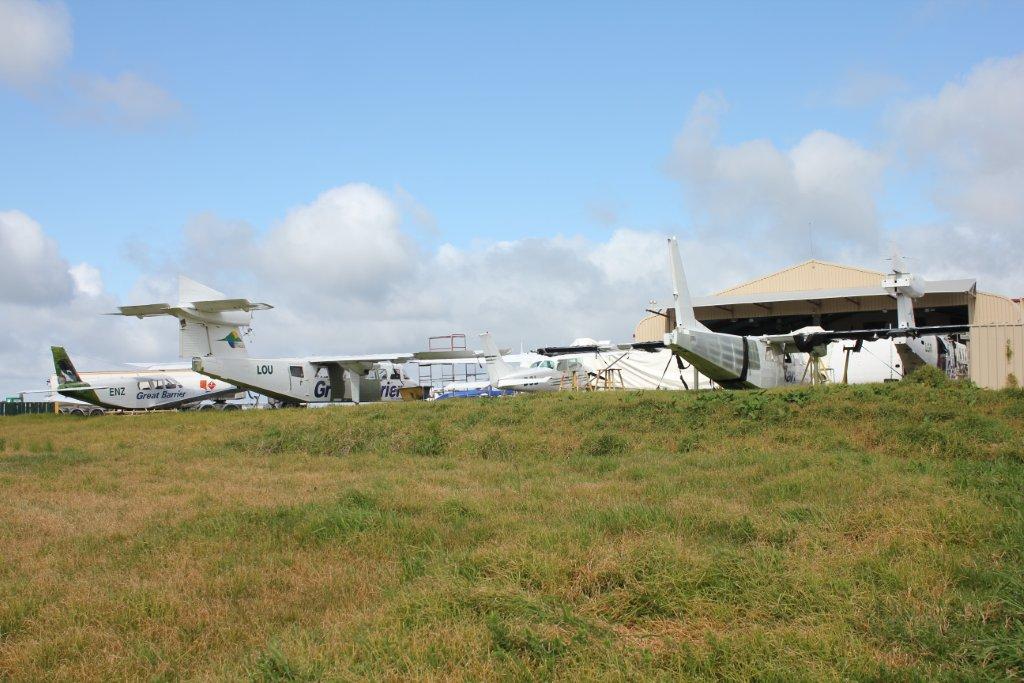
One wonders just exactly what's on the Great Barrier Airline's rebuild list... Out at North Shore on the 1st of September 2011 was Piper Pa32 Cherokee Six ZK-ENZ which is still available for use, BN Trislander ZK-LOU supposedly up for a rebuild, Cessna 172 ZK-DOL in for maintenance, long term rebuild project BN Islander ZK-KTR (though it has never been registered) and the new arrival BN Trislander ZK-LGR which was been hidden away for some years. Now a trio of Trislanders a red, white and blue one... that would make a great photo! Photo : S Lowe

Meanwhile, down the road, it looks as if the remains of ZK-WNZ are destined for the scrapheap. Photos taken at North Shore on 1 Septmeber 2011 by S Lowe
 

Needing a fly rather than a rebuild was Bell Jetranger ZK-HGD at North Shore on 1 September 2011. Photo : S Lowe

NAC's last De Havilland DH89 Dominie Service


While researching the current series of posts to Great Barrier Island at the Whangarei Library I came across some newspaper accounts of the end of the De Havilland DH89 Dominie service to Whangarei and the end of the type in NAC service... they make an interesting read...

Last Dominie Flight from Whangarei Tomorrow
- Northern Advocate 18 December 1963


An era in New Zealand aviation comes to an end tomorrow with the last Dominie flight out of Whangarei. Onerahi airport is being closed for runway reconstruction to allow DC3 aircraft to use it in the future, and with this goes the last of the six-seater bi-planes that have it been a distinctive feature of the New Zealand airways for many years. The National Airways Corporation had six Dominies. They-served on many routes: Dunedin-Invercargill; the South Island West Coast; Auckland-Rotorua; Auckland-Hamilton-Rotorua: across Cook Strait and (under charter) Hokitika-Milford Sound; Whangarei-Auckland. The last of the six, ZK–AKY "Tui”, will make her last scheduled flight from Whangarei to Auckland tomorrow afternoon. Dominies were far from welcome they first began the Whangarei run in March 1950. Since 1948, Whangarei had enjoyed a twice-daily Electra service and a daily allocation of 19 to 22 passengers in the Northland network. But with the retirement of the 10-seater Electras, Onerahi airport was too small for the replacement Lodestars and news that Whangarei would have to be happy with the Dominie came as something of a shock. There was a further shock in store when in July of that same year the then Minister for Civil Aviation, Mr W. S. Goosman, indicated that the Dominie itself might be out of service within two years.

Kept on Flying

The alternatives offered replacement aircraft or enlargement of Onerahi airport to Lodestar standards, sparked off a series of meetings and demands for a larger airport, intermingled with pessimistic forecasts of a "humiliated” Whangarei left without an air service of any kind inside two years. In spite of the most gloomy forebodings, however, and in-spite of the minister’s statement: "We are not keen to continue their use beyond the next two years," the Dominie has kept on flying. "Tui", the aircraft that will make the last scheduled flight tomorrow and is the last of the original six, has flown a total of 16,700 hours. Since they commenced service in 1950, the Dominies have carried a total of 121,670 passengers in and out of Whangarei. In the first year they carried 10,148 people and in the first quarter of their last year up to November 30, 1963, they carried 5164. During the year of operations from Whangarei, Dominies extended their flights to provide a feeder service between Kaikohe and Whangarei. Their record is without blemish - never a mishap; never a passenger injured. At busy periods up to six return flights, a day have been flown, using two aircraft. In contrast to the Dominie, which was referred to with contempt as a "baby plane" when introduced in 1950, the Douglas DC-3 Skyliner which will replace it when the airport is reopened next year has the dimensions of a giant. Comparative figures for the Douglas with those of the Dominie in parentheses, are: Length 64ft 5½in (34ft 6in); wing span 95ft (48ft); maximum permissible weight 26,900 lbs (5500lbs) cruising speed 160mph (115mph); top speed 231mph (157mph); fuel consumption 65 gal/hr (17 gal/hr); fuel tank capacity 668 gals (76,gals). De Havilland aircraft hold a proud place in the history of both military and civil aviation. In New Zealand the Dominies have surrounded themselves with history, some of it true, some of it almost legend. Tales are told by veteran pilots of the easy-going days when they dropped newspapers to isolated lighthouses, when cases of fruit were used as ballast; of unscheduled calls at remote farms for a friendly cup of tea and lengthy, hospitality-filled disruption periods on the West Coast. The amazingly rapid development of the Dominie family began in England in 1932 with an urgent need for practical, one-pilot, twin-engine transport aircraft. Drawings were started early in the year and the first three aircraft in the noble De Havilland line took the air only four months later. This aircraft, the DH Dragon, was soon flying on United Kingdom and Channel routes and it was an immediate and continued success with both pilots and public. As father of the De Havilland's transport fleet, the Dragon contributed a great deal to the growing prestige of British aviation. One historic flight, the 3300 mile, 39-hour North Atlantic crossing made by the Mollisons, ranks among the great journeys of all times. From the Dragon, De Havilland developed the first of their four-.engined aircraft, the DH 86, three of which flew with Union Airways, in New Zealand. Another two-engined aircraft which grew from the original Dragon line was the Raplde DH89 which first flew in April 1934. The main changes between the Dragon and the Rapide were higher-powered engines; metal propellers, faired under-carriage and tapered wings. Like its predecessor, the Rapide was an immediate favourite and even before World War II, De Havilland had built 200 of this type. During the war the main manufacturer's built a further 200 While no less than 275 were manufactured in - of all places - a furniture factory. Production finally ended, somewhat reluctantly, in 1945. The RAF gave the Rapide new engines and a new name: Dominie. In service life it flew various missions: - navigational and radio training, bombing practice, communications, ambulance work and photography. In civilian role the little aircraft filled some of these tasks, and added others as well.

Flying Doctor

In Australia it was part of the famous Flying Doctor service; in Northern Canada the wheels were replaced with floats and it became a seaplane. From time to time further modifications were made: better engines, larger luggage space; but throughout the years the Dominie kept all the nostalgic aspects of early flying days: struts, wires, fabrics, low-octane fuel (73) - and its petrol tank tops were conveniently locked with a safety-pin.

De Havilland Dominie ZK-AKY "Tui" at Whangarei's Onerahi Airport in May 1963. Photographer Unknown - S Lowe Collection

Last Plane until Runway Extended
- Northern Advocate, 20 December 1963

An informal afternoon – tea in the terminal lounge at Onerahi airport – yesterday marked the last NAC passenger air service to Whangarei until runway extensions are completed. It was also intended to mark the withdrawal from service of NAC’s last Dominie, ZK-AKY “Tui” and was timed to coincide with the last scheduled flight from Onerahi at Onerahi at 4.30pm. However, the Dominie was grounded by poor visibility at Whenuapai which cancelled the two afternoon flights and the last take off from Onerahi was about 11:30 a.m. four and a half hours before the function commenced. Arranged for NAC by Mr T. R.

Roseman, the NAC agent here, the function was attended by members of the Whangarei Airport Committee, Chamber of Commerce and local body representatives. Mr Roseman also welcomed Messrs A. Marsden-Woods and W J Court as veteran patrons of the early passenger service to Whangarei and Mr P. R. Going as one of the first airmail pilots.

'Wonderful Job'

The mayor and chairman of the Whangarei Airport Committee (Mr J. F. Johnson) said services in the future were likely to be less frequent because of the increased capacity of DC3 aircraft. The Dominie had done a wonderful job, he said. Mr Johnson said he hoped the Minister in charge of Civil Aviation’s (Mr McAlpine) would announce, the acceptance of McBreen Jenkins' tender for the airport re-construction today. This would mean machinery could move in on the job immediately. Mr Johnson also read a message from the general manager of NAC (Mr D. A.Patterson) who commented on the withdrawal of the Dominie service as the passing of an historic link in New Zealand aviation network, but added that the corporation looked forward to the day when Whangarei would again enter the NAC flying pattern. Mr Johnson said increased costs of the runway extensions would mean a considerably larger burden on the ratepayers of the district and he hoped the service would be used sufficiently to warrant this. He added, however, that although he could not give any further detail he “could see something better looming up for Whangarei."

Assurance Asked

Asked later; if his remarks referred to the possibility of Friendship aircraft being used, on the Whangarei run, Mr Johnson said, there had to be a replacement to the DC3 and the Friendship was the only one he knew of at the moment. The Whangarei Borough Council has asked for an assurance that suitable replacement aircraft will be provided to give continued full service when DC3's were withdrawn, added Mr Johnson. Other speakers were Mr Court. Mr T. H. Busck for the Chamber of Commerce and Mr Going. On behalf of NAC Mr Roseman thanked the pilots, CAA staff and Ministry of Works officials who had worked to keep the Dominie service operating over the years. The distinction of piloting the last scheduled passenger flight in a Dominie came unexpectedly to Captain S. Trounce, a senior pilot with the National Airways Corporation. His flight which left Onerahi about 11.30 a.m. with three passengers proved to be the last when the Dominie was grounded at Whenuapai due to poor visibility cancelling the remaining two flights in the afternoon. Captain on the 4.40 p.m. flight for which a special function had been organised at Onerahi, would have been another senior NAC pilot, Captain D. Barnston.

‘Beautiful Aircraft’

Because Dominies were soon be withdrawn no new pilots had been given training on them in recent years said Captain Trounce. As a result Whangarei had enjoyed a service manned exclusively by NAC's 10 senior captains. To Captain Trounce the Dominie is a "beautiful aircraft", and he says it has been a pleasure to fly it and this Whangarei route. However, he believed Whangarei will benefit from an improved, if less frequent service, with the introduction of DC3 aircraft when runway extensions are completed. Dominies are only cleared for visual flying range and there have been times when Onerahi has been closed because of surface conditions, he said. A stabilised strip and suitable radio aids would overcame these problems. The three passengers on what finally proved to be the last flight were all Whangarei people. They were Mr B. J. Binnie of Nixon St., who works at Whakatane: Kathleeen Farnbam, 11, of Ruakaka, who was travelling to New Plymouth; .and Mr J. O. L. Blake, Mangapai, heading for Dunedin. Only two people missed out on what was to have been the last flight and they included the wife of an NAC pilot, Mrs J Crooks who with her infant daughter was due to fly home to Wellington. The other passenger was a Miss M Dainty, also of Wellington. They travelled to Auckland by road.

Northern Advocate 20 December 1963